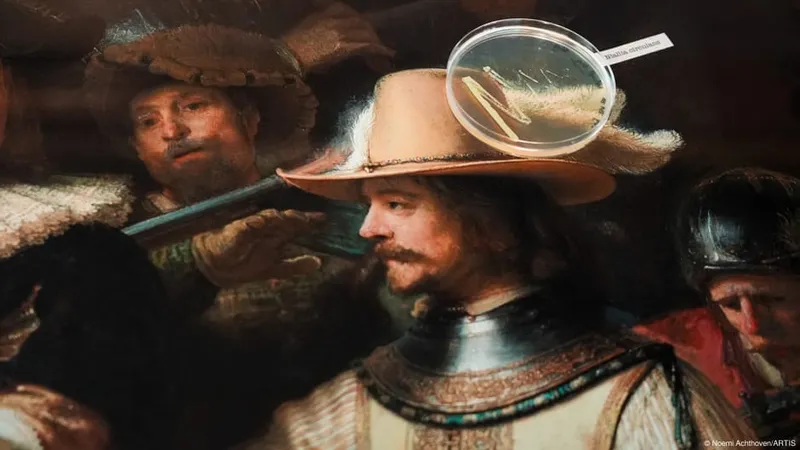
What is crawling on Rembrandt's 'The Night Watch'?
Scientists have discovered microscopic organisms living on the surface of Rembrandt's famous 'The Night Watch' painting at Amsterdam's Rijksmuseum.
Rembrandt van Rijn's 'The Night Watch' is one of the most famous paintings of the Dutch Golden Age. Amsterdam's Rijksmuseum, where the work is on display, hails the artist's 1642 masterpiece as 'the turning point in his career and as the superlative example of his creative genius.'
In the painting, Rembrandt made dramatic use of light and shadow to guide the viewer's eye to key figures. Unlike static group portraits typical of his era, the artist depicted Amsterdam's civic guards in mid-action, as they prepare to march out.
Beyond the sense of movement featured in 'The Night Watch,' the painting itself is also alive in a way that's rarely taken into consideration — through the microscopic organisms living on the canvas.
Microbial research
The research project 'The Night Watch Lives' explores exactly that question: What kinds of life forms inhabit the surface of the famous painting? The study is a collaborative scientific and exhibition project between the Rijksmuseum and ARTIS-Micropia — an Amsterdam museum dedicated to the world of microorganisms.
It's part of the broader 'Operation Night Watch' restoration and research project described as the 'biggest and most wide-ranging ever study and restoration of Rembrandt's most famous painting,' started in 2019. Conservators and scientists in this project have been examining every aspect of Rembrandt's masterpiece using cutting-edge technology, seeking new insights into its materials, condition and history — and now, its microbiome.
The idea behind 'The Night Watch Lives' was to 'put microbes in a positive spotlight,' Eline van Bloois, who led the research, told DW. 'Honestly, if you're asking me — I'm a microbiologist, so I'm biased of course — but they really deserve more positive attention.'
Exhibition reveals findings
Over a period of six months, van Bloois will be taking samples once a month directly from the famous painting at the Rijksmuseum, accompanied by the people working on the restoration of 'The Night Watch.' Using small sterile discs gently pressed against selected areas of the painting, the samples collect microscopic material from both varnished and unvarnished sections.
These samples are then cultivated in laboratories, allowing previously invisible microbes to grow into visible colonies that can be studied and identified. At the 'The Night Watch Lives' exhibition, visitors can view Petri dishes containing the cultivated microbial colonies. A life-size reproduction of Rembrandt's masterpiece also shows where the samples were taken, and which microorganisms were found there.
At the opening of the exhibition on November 11, the installation included the findings of two of van Bloois' sampling sessions. Four more will be added over the upcoming months, allowing the museum's visitors to follow the results of the study as it unfolds. That means the exhibition's visitors 'will be figuring out what I've found as I'm figuring it out myself,' explains the microbiologist. 'We really take them through that journey with us.'
People often fear microbes or associate them with disease, even though the vast majority of these microscopic organisms are actually harmless or vital to human survival. Some of the organisms found on the painting 'are very commonly found on human skin, for instance, and they're a healthy part of the microbiome; most humans actually have these bacteria with them,' says van Bloois, adding that the presence of these microbes on the painting made sense, since humans are often near the work.
Related
