Mike McGlone Warns Crypto Could Collapse Like NFTs as ‘Everything Bubble’ Deflates
Bloomberg Intelligence senior commodity strategist Mike McGlone warned on November 23 that cryptocurrencies could collapse like NFTs as the 'Everything Bubble' deflates.
McGlone warned that weakness in Bitcoin and other cryptocurrencies could spread into a broader correction across risk assets including stocks and commodities. He suggested some digital assets could eventually fall close to zero, similar to the collapse in the nonfungible token market.
NFT warning
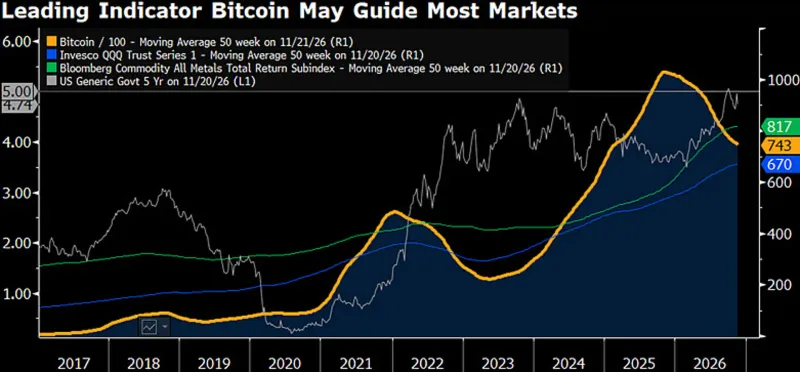
On November 23, McGlone wrote on X that the 'Everything Bubble' is deflating, noting that Bitcoin's bear market since October 2025 may offer an early signal for what lies ahead for U.S. stocks, gold, metals and commodity markets. He pointed to the NFT market as a warning for digital assets, stating crypto is following the same path.
Some tokens with no link to underlying value, including Dogecoin, could eventually fall close to zero over the long term.
Bitcoin outlook
For Bitcoin, McGlone cited about $10,000 as one long-term downside reference point that could flush out excessive speculation, though he did not directly predict it would reach that level. He described Bitcoin at around $10,000 as an appropriate 'gravity-pull pivot' that could halt speculative excess.
McGlone also noted that the decline could feature repeated sharp short-covering rallies, citing Bitcoin's rebound from about $58,000 in June to about $86,000 in September. He warned that Bitcoin's weakness could spill over into other risk assets as it shows signs of rolling over from its peaks alongside a Nasdaq-100 tracking ETF and metals commodity indexes.
Broader market impact
Rising U.S. Treasury yields and the Federal Reserve's tight policy stance could weigh on asset prices, according to McGlone. He also predicted crude oil could fall to about $40 a barrel and copper could drop below $5 a pound before the Fed ultimately pivots toward easier monetary policy.
McGlone described the current cycle as a normal transition from inflation to deflation, suggesting these market movements are part of a broader economic adjustment rather than isolated events.
Related


