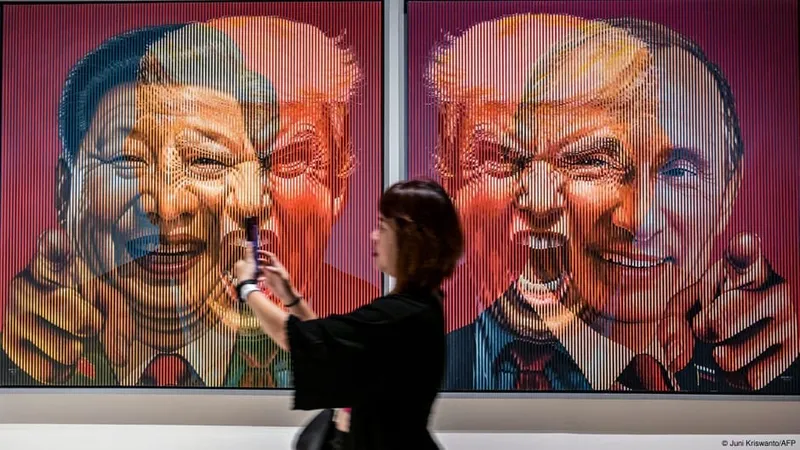
Trump, Xi and Putin will hold their first trilateral meeting during APEC. DW looks at what each of the leaders wants
Leaders of the United States, China and Russia will hold their first trilateral meeting on the sidelines of the APEC summit in Shenzhen this week, with US President Donald Trump also set for separate talks with Chinese President Xi Jinping.
The November 18-19 gathering in Shenzhen, China, marks a significant diplomatic moment as the leaders of the world's three major powers convene. The trilateral meeting follows separate bilateral talks between Trump and Xi, with both interactions occurring against a backdrop of complex international challenges including trade disputes, regional conflicts, and shifting global alliances.
Several experts interviewed by Deutsche Welle do not anticipate breakthroughs on US-China trade, technology or other contentious issues. Instead, maintaining the existing trade truce and preventing bilateral relations from deteriorating further may be the more realistic shared objectives.
Trade tensions and expectations
Patricia M. Kim, a senior fellow at the Brookings Institution, believes neither leader is looking to significantly expand the bilateral agenda, as both have an incentive in maintaining the existing trade truce. Over the next two years, Kim expects to see "neither uncontrolled escalation in tensions between the US and China nor a dramatic improvement in ties, but rather the continuation of the transactional détente we see today."
Neither uncontrolled escalation in tensions between the US and China nor a dramatic improvement in ties, but rather the continuation of the transactional détente we see today.
Jia Hui Tee, a senior trade policy analyst at the Hinrich Foundation, expects Trump and Xi to focus on stabilizing their fragile trade relationship. She suggests the two leaders could make progress on reciprocal tariff cuts covering goods worth $30 billion on each side, though the timeline for implementation remains unset.
Three leaders, three agendas
Russia hopes that talks with the leaders of the US and China will enhance its diplomatic standing and help secure a settlement to the war in Ukraine on terms favorable to Moscow. Yun Sun, director of the China Program at the Stimson Center, told DW that Moscow wants to create the impression that Washington is willing to sit down with Russia and negotiate, potentially undermining confidence in Europe and Ukraine.
Beijing aims to demonstrate its ability to bring major powers together and facilitate international dialogue. Alicia Bachulska, a policy fellow at the European Council on Foreign Relations, summarized the differing priorities: Russia wants recognition, the US wants arms control, and China wants status without strings attached. I expect each leader to restate their own positions rather than produce real solutions.
Ukraine and Iran complexities
Regarding Ukraine, Michael Kimmage, director of the Kennan Institute, believes China may be more concerned with the survival of Putin's regime than with actively bringing the war to an end. Zhang Lun argues that the Trump administration's pro-Putin stance has weakened Ukraine and eroded America's moral authority, while simultaneously enhancing China's position and influence.
On Iran, W.A. Figueroa, an assistant professor at the University of Groningen, notes little indication of substantive cooperation between China and the US. While both countries share interests in opposing a toll system in the Strait of Hormuz and nuclear proliferation, China has consistently called for negotiations while continuing to provide Iran with crucial financial support through oil purchases.
Related
