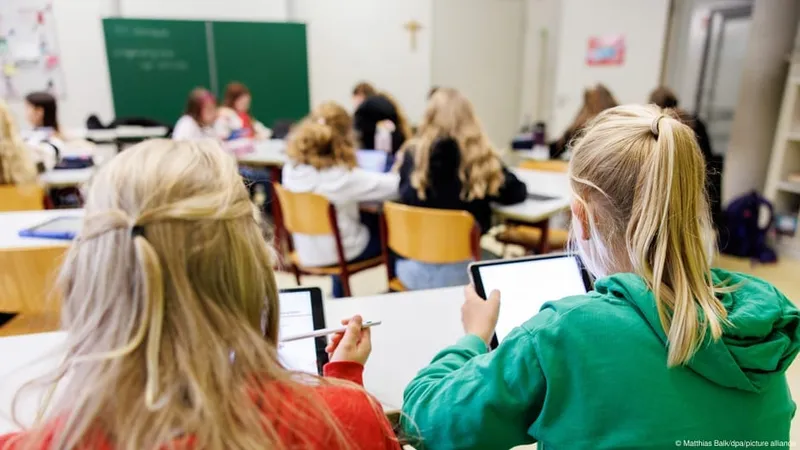
AI in classrooms: Fighting the great 'dumbing down'
German teachers report that students increasingly use AI tools to solve problems, leading to lower test scores and a decline in independent thinking.
Jakob, a 15-year-old student at a German gymnasium, uses ChatGPT to prepare for his French tests. He is not alone; many of his classmates rely on AI to solve problems in math, German, English, chemistry, and physics.
This phenomenon, termed "cognitive outsourcing," involves shifting the entire problem-solving process to an AI, unlike a calculator which handles only a step or two. While Jakob insists he only uses AI when truly stuck, other students are more reliant on it.
Franziska Müller, a veteran teacher, has noticed a troubling trend. She says some students cannot think for themselves and read less because they let AI summarize everything. They often read out AI-prepared answers in class, hoping to avoid detection.
"They can't even think for themselves anymore," Müller told DW, highlighting the concern over students' declining comprehension and independent thought.
PISA study links AI use to lower scores
The OECD's latest PISA study, which evaluates 15-year-olds in over 90 countries, found that students who use AI chatbots score lower in science on average. This includes using AI to summarize texts, conduct research, or draft assignments.
German 15-year-olds posted their lowest PISA scores in the 25-year history of the study. OECD director Andreas Schleicher explained that learning does not come from consuming content but from the mind's productive cognitive engagement with new material.
The Brookings Institution argues that the risks of using AI in education outweigh the benefits. Its research indicates students are losing fundamental cognitive skills, critical thinking, memory, and independent judgment as they rely on AI to do their intellectual work.
"Just as we don't get fit by watching sports but by doing sports ourselves, learning doesn't come from consuming content, but from the mind's productive cognitive engagement with new material," Schleicher explained.
Germany's response and high AI adoption
New York Mayor Zohran Mamdani has banned the use of AI in public schools up to the eighth grade for the 2026 and 2027 school years. However, German teacher Julian Hinn believes such bans are ineffective, noting students can still use AI apps on their phones.
The German Standing Conference of the Ministers of Education and Cultural Affairs (KMK) has issued statements on AI use since 2024. However, these guidelines are vague, stating only that students should engage with AI in a critical, reflective, and responsible manner.
Similar high figures are observed in Asia, Latin America, and the US.
Teachers navigate AI's benefits and risks
Teachers like Hinn and Müller are trying to find a balance. Hinn, who teaches students aged 15 to 18, believes AI should be introduced in the 10th grade and used strategically. He encourages students to question AI critically and assess the quality of its solutions.
Müller has integrated some AI use into her lessons for older students but bans it in other areas to force students to think for themselves. She understands the temptation to use AI but believes it ultimately does students no favors.
The Brookings study warns that AI can exacerbate preexisting inequalities. While students with basic skills can use AI to deepen their learning, those with gaps in knowledge tend to adopt AI's errors and fall even further behind.
This effect is known as the Matthew effect, where early success leads to better progress, while early struggles cause a growing lag. Teachers are now more motivated to challenge students to think independently and consider their personal autonomy.
The consequences of over-reliance
Hinn, who supervises the school newspaper, tells students they can use AI but emphasizes the value of writing with their own pen. He believes the feeling of personal authorship is spectacular and fosters a sense of responsibility.
Müller shared a recent example of a student who was upset after a poor exam result. The student confessed he felt he could no longer think for himself because of his reliance on AI.
This reality is stark during exam time, when students are not allowed to use any aids or AI. If they cannot solve problems by themselves, they will fail, forcing them to confront the limitations of their cognitive outsourcing.
Related
