Intel Publishes Benchmarks for D270 "Crescent Island" GPU, Claims Wins Over RTX PRO 6000 - TechPowerUp
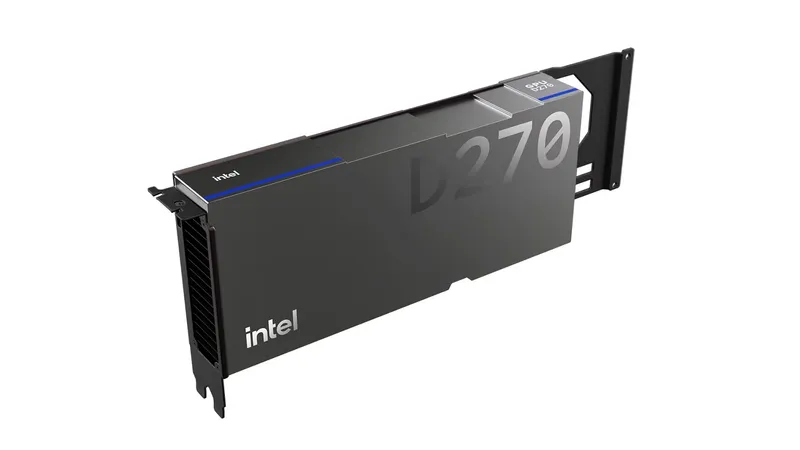
Intel has published benchmarks for its D270 'Crescent Island' AI accelerator GPU, claiming significant performance advantages over NVIDIA's RTX PRO 6000 in financial workloads.
Intel's D270 AI accelerator card, previously known as 'Crescent Island,' has been benchmarked by the company itself, showing impressive performance claims against NVIDIA's RTX PRO 6000 Blackwell Server Edition. The GPU demonstrated up to 5.9 times faster performance in FP64 financial workloads, with specific leads of 5.6x in European Black-Scholes, 4.6x in Binomial, and 1.92x in American Black-Scholes calculations.
A key advantage highlighted by Intel is the D270's power efficiency, operating at 350 W compared to the NVIDIA card's 600 W power limit. This performance advantage is attributed to the D270's 32 Xe3P cores, each handling 64 FP64 FMA operations at native full rate. These benchmark results were presented at SC26 in Chicago.
AI Performance
In AI workloads, Intel's claims are more modest. The company reports up to 29% lower latency on the Drex decision model and 1.12x the output token throughput on Qwen3-30B-A3B in FP8 when tested against a single RTX PRO 6000. Notably, in the financial tests, the NVIDIA system utilized eight RTX PRO 6000 cards against a single D270, though Intel didn't specify how many were used per individual test run.
Intel also demonstrated FP32 seismic modeling with Veridien, though performance figures were not provided for this test. The D270 'Crescent Island' GPU can support up to 480 GB of memory, while Intel-branded cards come with 160 GB of LPDDR5X as standard. All benchmark results are based on pre-production silicon and represent first-party data showcasing best-case scenarios for the D270.
Market Position
Despite the impressive benchmark results, Intel has not yet announced official pricing or a launch date for the D270 GPU. The company appears to be positioning the D270 as a competitive alternative to NVIDIA's offerings in both financial computing and AI workloads, though the more modest AI performance gains suggest NVIDIA may still hold advantages in certain AI applications.
Related
