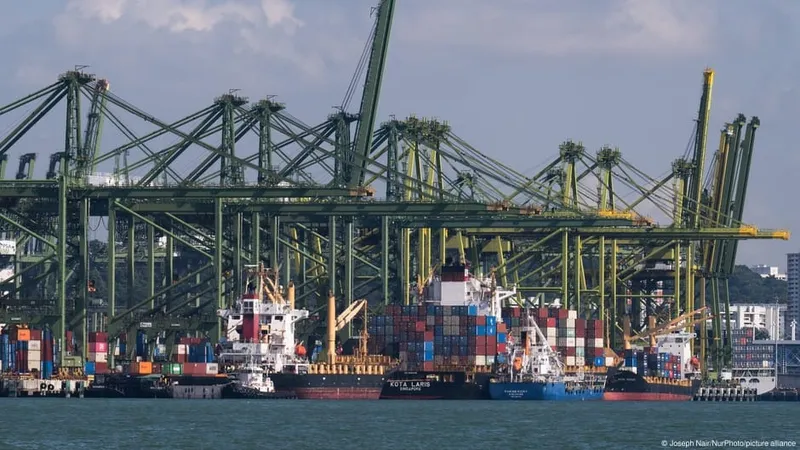
EU, ASEAN pursue deeper trade ties, but hurdles remain as businesses struggle with informal barriers
The European Union and ASEAN could be heading for a breakthrough year in 2027, when the two sides mark 50 years of diplomatic ties, with several trade deals nearing completion.
A long-awaited trade agreement with Indonesia is expected to take effect in 2027, while deals with the Philippines are nearing completion and negotiations with Thailand and Malaysia are making progress. By the end of next year, the EU could have trade deals in place with six Southeast Asian states, up from just two today.
On November 17, the European Commission hosted a dialogue in Brussels to discuss trade relations with Southeast Asia, including progress on existing and pending free trade agreements (FTAs). However, attention is now shifting to implementation challenges.
Implementation challenges
For Brussels, the priority should now be to tackle less conspicuous obstacles to trade, including cutting customs delays, simplifying regulations, and helping smaller European businesses enter unfamiliar Southeast Asian markets.
European companies with little experience in Southeast Asia would benefit from greater on-the-ground support, particularly practical guidance on informal business practices and unwritten local rules, according to Alfred Gerstl, an associate professor at Palacky University Olomouc.
Expanding assistance from European chambers of commerce, trade delegations, and EU offices in Southeast Asia could range from helping firms find distributors to explaining local licensing requirements and how to qualify for preferential tariffs.
Geopolitical considerations
Trade policy has acquired a geopolitical purpose in Brussels as the EU seeks to reduce dependencies on suppliers for minerals needed for batteries and clean technologies. Southeast Asian producers, particularly Indonesia, want foreign investors to help develop domestic processing industries rather than merely buy raw materials.
The EU and Indonesia have already clashed over Jakarta's restrictions on nickel exports. European investment in processing facilities, agreements on environmental standards, and greater regulatory certainty could benefit both sides.
The real value of an FTA is not just opening a market but giving the EU the leverage to keep it open.
Regional cooperation prospects
Pasha Hsieh, a professor at Singapore Management University, urged Brussels to prioritize ratifying investment protection agreements with Singapore and Vietnam, signed in 2018 and 2019 respectively, which still require ratification by all EU member states.
The EU and ASEAN launched negotiations for a region-wide FTA in 2007 but suspended them two years later amid disagreements. Technical discussions resumed in 2017 but have yielded little progress.
Humphrey called for negotiations on a region-to-region Digital Trade Agreement and Investment Protection Agreement, citing the EU-Singapore Digital Trade Agreement as a possible model. The 2027 anniversary could serve as a deadline for agreeing on next steps, though Gerstl warned against mistaking diplomatic ceremony for actual progress.
Related
