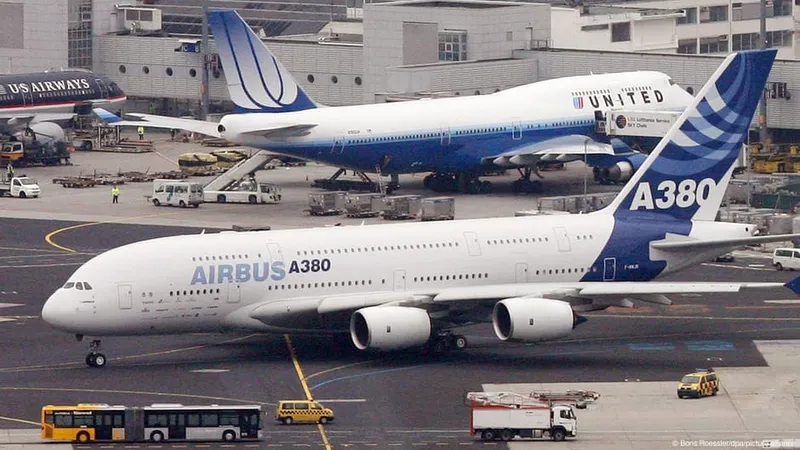
Could the Airbus' €3 billion loan row reignite a US-EU trade dispute?
The European Investment Bank's €3 billion loan to Airbus has sparked fresh trade concerns with the US, potentially reopening a long-running dispute between the economic powers.
The European Investment Bank (EIB), the lending arm of the EU, agreed in June to loan Airbus up to €3 billion ($3.4 billion), the largest corporate loan ever authorized by the bank. US President Donald Trump's top trade advisor recently suggested the loan breached a 2021 EU-US agreement on state support.
The EU insists the loan does not amount to subsidies, that it is in close contact with the Office of the US Trade Representative and "will provide all necessary information." An Airbus spokesperson told DW the company is "actively engaging with the relevant authorities and are happy to share more information about the loan with governments."
Historic trade dispute
Airbus and Boeing, the world's two largest plane manufacturers, were previously involved in a 17-year corporate trade dispute. The World Trade Organization ruled that both the EU and US provided the companies with state subsidies, resulting in years of tariffs and tit-for-tat retaliation.
A deal to end tariffs with strict provisions on state support was finally agreed in 2021 and strengthened in 2025. However, the latest row threatens to reopen the dispute and potentially endanger the wider EU-US tariff deal agreed last year.
Trade experts tend to hate to talk about it because there are so many ups and downs to the story, it took so long to get resolved and it always tends to creep back up again.
Loan legitimacy questioned
At the heart of the current dispute is whether the €3 billion loan amounts to illegal state support. The European Commission and EIB maintain it is "a standard loan on market terms" that carries interest and must be repaid in full, consistent with the bank's established procedures.
Airbus also describes the loan as "a standard corporate financing facility, similar to commercially available loans we've signed in the past." However, experts say the lines remain blurred between what counts as a subsidy versus a loan.
Another potential issue is how the €3 billion will be used, including the share earmarked for research and development and how much funding will support defense-related activities versus commercial aircraft development. The aerospace sector is complicated by defense contracts with governments and high R&D costs.
Possible escalation
Boeing originally asked the US trade representative to intervene over the loan, linking it to Airbus' plan to develop a new single-aisle aircraft program that could spark intense competition. The next step for the US could be to launch a Section 301 investigation to determine if the loan violates international trade agreements.
Inu Manak believes the Trump administration has no interest in engaging with the WTO and that the dispute has the potential to threaten the broader EU-US trade agreement. "They may think there may be something else to extract from the European Union," she said.
Fredrik Erixon agrees that "it's going to be a point of leverage that the Americans can use against Europe." He notes that both companies need greater government investment due to increased military spending, creating "a state aid race" that is inherently escalatory.
Related
