Google GTIG Warns AI Agents Automate Exploits, Steal Credentials and Scale Cybercrime - Security Affairs
Google’s Threat Intelligence Group (GTIG) has reported that attackers are using autonomous AI agents to automate exploits, steal credentials and scale intrusions, often sacrificing stealth for speed.
Google’s Threat Intelligence Group (GTIG) has reported that attackers are using autonomous AI agents to automate exploits, steal credentials and scale intrusions, often sacrificing stealth for speed.
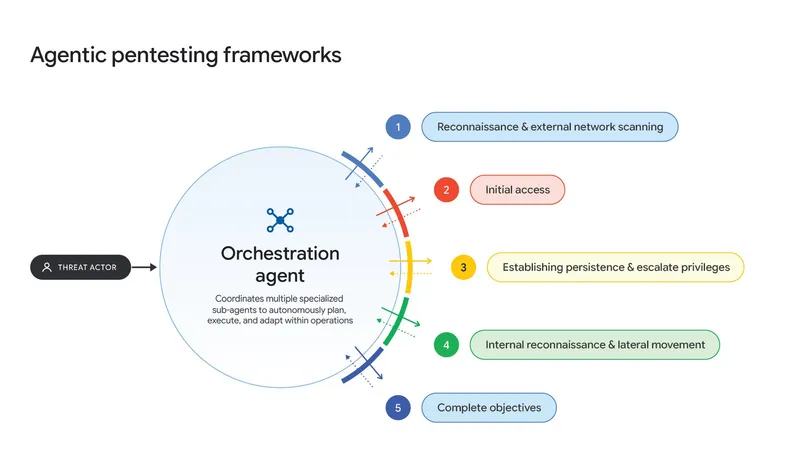
The company says threat actors have moved past typing prompts into a chatbot and now run autonomous, multi-agent frameworks such as ARTEX, CAIRN, CyberStrikeAI and PentAGI to carry out multi-stage intrusions faster.
These tools can find and exploit simple vulnerabilities, ask a large language model (LLM) to create custom payloads when needed, and change their approach based on the results they get.
Google found evidence of CAIRN and PentAGI being used in real attacks, while CyberStrikeAI and HexStrike AI were still being tested.
CAIRN allows different AI agents to work together and share information through a common workspace, and GTIG found evidence of its use against several targets, including organizations in the US aerospace sector.
CyberStrikeAI connects commercial and open-weight AI models to more than 100 security tools, while HexStrike AI gives LLM-based clients access to over 150 tools, managed by more than 12 specialized agents.
PentAGI is designed for less experienced operators, and between late August and early October, one attacker used a modified version of the framework to systematically scan organizations across Asia.
A China-nexus group is also building its own framework, and others use ZeroHollow, an inference service for exploit development and routing, and Agent Zero, an open source agent framework that runs code on its own.
Adversary tradecraft has continued to transition beyond manual prompting to deploying autonomous multi-agent offensive frameworks—such as ARTEX, CAIRN, CyberStrikeAI, and PentAGI—to execute multi-stage intrusions at greater operational velocity.
Google expects the trend to continue, since the barrier to entry is low and adding exploits is easy.
For the first time, GTIG saw attackers automate discovery and exploitation with no human in the loop.
An exposed staging server hosted a framework called exploit_agent that compares popular web software before and after patches, drafts exploits and runs them.
Victim data suggested interest in French media, entertainment and education sites, and the configuration notes were in Russian and told the operator to put the API keys in the file, not in the chat.
Once a vulnerability is patched, attackers have more information to work with.
They can study the affected code, release notes, security research and proof-of-concept exploits to find ways to attack systems that have not yet been updated.
Between January and August 2026, the number of vulnerability disclosures and exploits nearly doubled.
Zero-day exploits also increased, from an average of 8 per month in 2025 to 11 in 2026, before reaching 22 in August.
The PaperCut case shows how quickly attackers can move.
Two flaws were exploited as zero-days in late August, and Huntress and other researchers developed working exploits within 24 hours.
GreyNoise detected an attack campaign just four days after the flaws were disclosed.
In one case, attackers went from gaining access to obtaining domain administrator privileges within minutes.
The same pattern appeared with two PHP vulnerabilities, CVE-2026-109618 and CVE-2026-109619.
Researchers used LLMs to analyse the flaws, and details about the patched code and a proof-of-concept video appeared before the October 21 patch.
Hundreds of exploit claims then emerged, but many did not work.
Defenders had to spend time checking which reports were genuine.
LLMjacking is the money side.
Attackers steal LLM credentials and cloud resources, then resell access.
Mandiant handled incidents where fraudulent charges passed $100,000 in a day, and the worst reached $1 million before cleanup.
They got in with credentials from public GitHub repositories and fake sites that harvest session tokens.
One actor used CVE-2026-40217, a LiteLLM sandbox escape that turns limited keys into admin credentials.
Some created and deleted short-lived service accounts to dodge rate limits, and others started powerful GPU instances.
In one case two attackers used the same credentials, and a botnet made millions of API calls in about 24 hours before they were revoked.
The loot goes to “LLM mixers,” storefronts that route buyers through pools of stolen credentials and compute.
“Threat actors frequently monetize LLMJacking intrusions by selling access to compromised compute and LLM resources. In addition to the rise of LLMJacking, GTIG is tracking the proliferation of “LLM Mixers”—illicit storefronts that provide buyers with unauthorized access to LLM services and underlying proxy infrastructure.”
This infrastructure routes buyer traffic through a pool of stolen credentials and compute instances to ensure reliable access, while also offering the ability to spread query volume across multiple victim environments to reduce the likelihood of detection.
GTIG saw prices from $0.10 to $25 per million tokens on Russian- and Chinese-language markets.
APIMart multiplies prices by five above 100,000 tokens, and JetNight sells monthly subscriptions.
Even criminals have a surcharge for long prompts.
Information operations now use LLMs as standard tools, and GTIG says so with high confidence.
That covers state groups tied to Russia, China and Iran, commercial influence vendors and profit-driven networks pumping out political clickbait.
Better content doesn’t automatically mean more impact, and profit networks can look like state campaigns.
In August, GTIG found a platform built on the Gemini API and other tools to automate personas, media, posting and distribution.
Prompts asked for local slang and deliberate typos, grainy phone-style photos with no background text, and residential proxies with saved login cookies.
Another vendor was building a platform for over 100,000 accounts using cloud phone farms and AI-simulated behavior to age new accounts, with plans to sell to its own government and foreign clients.
Nation-state actors use LLMs for productivity.
The Iranian actor CALANQUE ION, formerly APT42, uses them for reconnaissance and social engineering, and Chinese actors use them for research, scanning and exploits.
LEAKY CASTLE analyzes stolen data with them, others stage and exfiltrate through LLM platform file hosting, and North Korean IT workers use them for resumes and interviews.
MIDNIGHT NEPTUNE shows the creative end.
Fake recruiter profiles with SynthID watermarks led targets to ClickFix lures, and the attackers then edited .claude/settings. in internal repositories so that starting Claude Code downloaded the SOMBERMEME backdoor.
They also named access tokens after Microsoft Copilot.
The Jieyou phishing service added an LLM chatbot in June so low-skilled affiliates can edit phishing panels in plain language.
AI tools also have limitations that attackers must consider.
They can generate too much noise, make up details and even select the wrong targets.
Groups focused on espionage are therefore likely to use them with caution, while cybercrime groups may accept a lower success rate in exchange for reaching more victims.
Google SecOps has released detection rules for ARTEX, and Mandiant has published a guide to help organizations secure their systems.
Google’s assessment offers some room for defenders to act: these frameworks currently trade stealth for velocity.
Our own analysis makes a similar point: Many ARTEX “indicators” found on compromised systems are generated by the LLM or by the tools it uses, rather than being built into the framework.
This makes attacker behavior more useful to defenders than looking for a single string or signature.
When these frameworks run autonomously without tight controls, they leave traces in network traffic, recognizable identifiers and the code they execute.
AI tools help attackers scale attacks
Google’s Threat Intelligence Group (GTIG) has reported that attackers are using autonomous AI agents to automate exploits, steal credentials and scale intrusions, often sacrificing stealth for speed.
The company says threat actors have moved past typing prompts into a chatbot and now run autonomous, multi-agent frameworks such as ARTEX, CAIRN, CyberStrikeAI and PentAGI to carry out multi-stage intrusions faster.
These tools can find and exploit simple vulnerabilities, ask a large language model (LLM) to create custom payloads when needed, and change their approach based on the results they get.
Google found evidence of CAIRN and PentAGI being used in real attacks, while CyberStrikeAI and HexStrike AI were still being tested.
CAIRN allows different AI agents to work together and share information through a common workspace, and GTIG found evidence of its use against several targets, including organizations in the US aerospace sector.
CyberStrikeAI connects commercial and open-weight AI models to more than 100 security tools, while HexStrike AI gives LLM-based clients access to over 150 tools, managed by more than 12 specialized agents.
PentAGI is designed for less experienced operators, and between late August and early October, one attacker used a modified version of the framework to systematically scan organizations across Asia.
A China-nexus group is also building its own framework, and others use ZeroHollow, an inference service for exploit development and routing, and Agent Zero, an open source agent framework that runs code on its own.
Adversary tradecraft has continued to transition beyond manual prompting to deploying autonomous multi-agent offensive frameworks—such as ARTEX, CAIRN, CyberStrikeAI, and PentAGI—to execute multi-stage intrusions at greater operational velocity.
Google expects the trend to continue, since the barrier to entry is low and adding exploits is easy.
For the first time, GTIG saw attackers automate discovery and exploitation with no human in the loop.
An exposed staging server hosted a framework called exploit_agent that compares popular web software before and after patches, drafts exploits and runs them.
Victim data suggested interest in French media, entertainment and education sites, and the configuration notes were in Russian and told the operator to put the API keys in the file, not in the chat.
Once a vulnerability is patched, attackers have more information to work with.
They can study the affected code, release notes, security research and proof-of-concept exploits to find ways to attack systems that have not yet been updated.
Between January and August 2026, the number of vulnerability disclosures and exploits nearly doubled.
Zero-day exploits also increased, from an average of 8 per month in 2025 to 11 in 2026, before reaching 22 in August.
The PaperCut case shows how quickly attackers can move.
Two flaws were exploited as zero-days in late August, and Huntress and other researchers developed working exploits within 24 hours.
GreyNoise detected an attack campaign just four days after the flaws were disclosed.
In one case, attackers went from gaining access to obtaining domain administrator privileges within minutes.
The same pattern appeared with two PHP vulnerabilities, CVE-2026-109618 and CVE-2026-109619.
Researchers used LLMs to analyse the flaws, and details about the patched code and a proof-of-concept video appeared before the October 21 patch.
Hundreds of exploit claims then emerged, but many did not work.
Defenders had to spend time checking which reports were genuine.
LLMjacking is the money side.
Attackers steal LLM credentials and cloud resources, then resell access.
Mandiant handled incidents where fraudulent charges passed $100,000 in a day, and the worst reached $1 million before cleanup.
They got in with credentials from public GitHub repositories and fake sites that harvest session tokens.
One actor used CVE-2026-40217, a LiteLLM sandbox escape that turns limited keys into admin credentials.
Some created and deleted short-lived service accounts to dodge rate limits, and others started powerful GPU instances.
In one case two attackers used the same credentials, and a botnet made millions of API calls in about 24 hours before they were revoked.
The loot goes to “LLM mixers,” storefronts that route buyers through pools of stolen credentials and compute.
“Threat actors frequently monetize LLMJacking intrusions by selling access to compromised compute and LLM resources. In addition to the rise of LLMJacking, GTIG is tracking the proliferation of “LLM Mixers”—illicit storefronts that provide buyers with unauthorized access to LLM services and underlying proxy infrastructure.”
This infrastructure routes buyer traffic through a pool of stolen credentials and compute instances to ensure reliable access, while also offering the ability to spread query volume across multiple victim environments to reduce the likelihood of detection.
GTIG saw prices from $0.10 to $25 per million tokens on Russian- and Chinese-language markets.
APIMart multiplies prices by five above 100,000 tokens, and JetNight sells monthly subscriptions.
Even criminals have a surcharge for long prompts.
Information operations now use LLMs as standard tools, and GTIG says so with high confidence.
That covers state groups tied to Russia, China and Iran, commercial influence vendors and profit-driven networks pumping out political clickbait.
Better content doesn’t automatically mean more impact, and profit networks can look like state campaigns.
In August, GTIG found a platform built on the Gemini API and other tools to automate personas, media, posting and distribution.
Prompts asked for local slang and deliberate typos, grainy phone-style photos with no background text, and residential proxies with saved login cookies.
Another vendor was building a platform for over 100,000 accounts using cloud phone farms and AI-simulated behavior to age new accounts, with plans to sell to its own government and foreign clients.
Nation-state actors use LLMs for productivity.
The Iranian actor CALANQUE ION, formerly APT42, uses them for reconnaissance and social engineering, and Chinese actors use them for research, scanning and exploits.
LEAKY CASTLE analyzes stolen data with them, others stage and exfiltrate through LLM platform file hosting, and North Korean IT workers use them for resumes and interviews.
MIDNIGHT NEPTUNE shows the creative end.
Fake recruiter profiles with SynthID watermarks led targets to ClickFix lures, and the attackers then edited .claude/settings. in internal repositories so that starting Claude Code downloaded the SOMBERMEME backdoor.
They also named access tokens after Microsoft Copilot.
The Jieyou phishing service added an LLM chatbot in June so low-skilled affiliates can edit phishing panels in plain language.
AI tools also have limitations that attackers must consider.
They can generate too much noise, make up details and even select the wrong targets.
Groups focused on espionage are therefore likely to use them with caution, while cybercrime groups may accept a lower success rate in exchange for reaching more victims.
Google SecOps has released detection rules for ARTEX, and Mandiant has published a guide to help organizations secure their systems.
Google’s assessment offers some room for defenders to act: these frameworks currently trade stealth for velocity.
Our own analysis makes a similar point: Many ARTEX “indicators” found on compromised systems are generated by the LLM or by the tools it uses, rather than being built into the framework.
This makes attacker behavior more useful to defenders than looking for a single string or signature.
When these frameworks run autonomously without tight controls, they leave traces in network traffic, recognizable identifiers and the code they execute.
Related
