Hackers Inject Malware Into 178 Major Brands’ Websites via Optimizely to Steal Credit Cards and Cryptocur... - GBHackers News
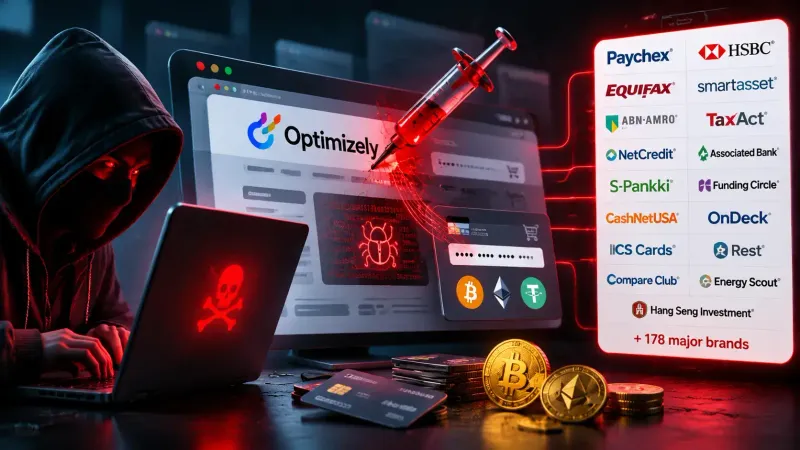
Hackers injected malicious JavaScript into Optimizely Web projects used by 178 organizations on November 16, 2026, exposing visitors to cryptocurrency theft, payment card skimming, and mobile exploit delivery.
The attack exploited Optimizely’s Project JavaScript feature, which lets customers run custom code across pages. Attackers inserted a loader into this field while leaving surrounding snippet code untouched.
Because websites already trusted Optimizely’s CDN, browsers downloaded the modified scripts through an established integration. The incident illustrates how JavaScript supply-chain attacks can turn legitimate dependencies into delivery mechanisms without modifying a victim website’s own application code.
According to the Report URI investigation, injected loaders fetched track.js from 1688360[.]cc. Investigators observed plain script references, Base64-encoded URLs decoded through atob(), and inline payloads executed through eval().
Financial and Data Theft
The payload replaced valid cryptocurrency addresses with attacker-controlled alternatives across page content, form fields, clipboard operations, network requests, and navigation. Supported currencies included Bitcoin, Ethereum, TRON, Solana, Litecoin, and Dogecoin.
A payment collection module added at 13:43 UTC monitored form submissions and outgoing POST requests for card numbers, expiry dates, and CVVs. Like other JavaScript credit card skimmers, it harvested information entered into accessible checkout fields.
It validated card numbers using the Luhn algorithm and transmitted complete records through navigator.sendBeacon() to 1688360[.]cc/card.php. Separately hosted payment iframes remained outside its reach.
The malware also collected page URLs, accessible cookies, original wallet addresses, and screenshots rendered with html2canvas. Cookies marked HttpOnly were inaccessible through document.cookie.
Researchers reported that approximately $7,040 reached associated wallets within roughly nine hours. However, wallet receipts do not establish the campaign’s full financial impact.
Mobile Exploits and Cleanup
On iPhones and iPads, hidden frames delivered version-selected Coruna and DarkSword chains through two routing domains. The approach parallels previously documented Coruna and DarkSword distribution through compromised websites and abandoned analytics integrations.
Researchers observed repeated exploitation attempts on older iOS devices; an iOS 26 route reportedly performed fingerprinting rather than confirmed exploitation.
By 21:52 UTC, researchers found malicious code remaining in only one of the 188 identified snippets, associated with TalkTalk. Cleanup did not establish how attackers obtained access or whether stolen information remained exploitable.
Defenders should inspect Project JavaScript, preserve suspicious snippets, investigate unexpected destinations, and monitor script changes. Enforcing a Content Security Policy can restrict malicious loading and connections, while updating vulnerable iPhones addresses the vulnerabilities these chains exploit.
