Intel GPU D270: 5.9x Over RTX PRO 6000 at 350 W - shattered.io
Intel claims its new GPU D270 delivers up to 5.9 times the application throughput of NVIDIA's RTX PRO 6000 in European Monte Carlo options-pricing tests while consuming 350 W compared to NVIDIA's 600 W.
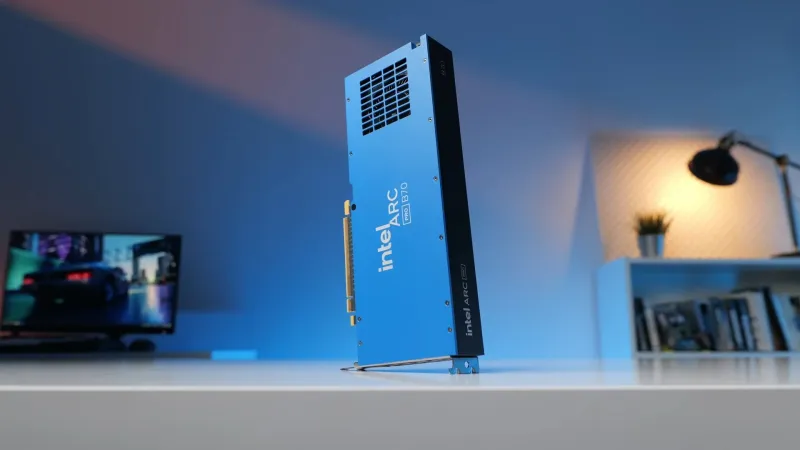
Intel's next-generation data-center accelerator, the GPU D270 (codenamed Crescent Island), claims up to 5.9 times higher application throughput than NVIDIA's RTX PRO 6000 Blackwell Server Edition in European Monte Carlo options-pricing tests. The D270 operates at 350 W, significantly lower than the NVIDIA card's 600 W consumption, according to Intel's own benchmarks reported by Wccftech and SSBCrack.
These performance claims arrive amid investor scrutiny of NVIDIA's AI chip dominance following leadership changes. Intel is strategically targeting double-precision math capabilities rather than NVIDIA's stronger AI training market, where the company holds an estimated 85.2% share.
FP64 Performance Advantage
The D270's architecture features 32 Xe cores and 256 Xe Matrix Extensions (XMX) engines, with each Xe core delivering 64 FP64 fused multiply-add operations. This full-rate FP64 capability is crucial for financial workloads where precision matters, unlike AI training which often uses lower precision formats like FP8 or FP4.
Intel reported multiple benchmark results against the NVIDIA card: 5.6x for European Black-Scholes, 4.6x for binomial pricing, and 1.92x for American Black-Scholes. These variations reflect how different computational approaches affect performance, with the most parallelizable workloads showing the greatest advantages.
The more a workload depends on sequential decisions and memory access patterns, the less raw FP64 throughput decides the outcome.
Power Efficiency and AI Capabilities
The power difference between the cards creates a compelling efficiency argument. If Intel's throughput claims hold, the D270 would deliver approximately 10x better performance per watt on the best workloads. However, these calculations use rated power figures rather than measured draw under actual load.
For AI workloads, Intel reported up to 29% lower latency than the NVIDIA card on Drex 2.0, positioning the D270 as a dual-purpose solution for both financial simulation and AI inference. This modest but meaningful latency improvement could benefit real-time applications like trading or fraud detection.
Market Context and Caveats
Intel emphasizes that these results come from pre-production silicon and may vary with final hardware. Pre-production chips often run at conservative clocks with immature firmware, making final performance uncertain. The company hasn't published pricing or detailed specifications beyond the core architecture and benchmark claims.
The D270 represents Intel's attempt to consolidate workloads currently handled by separate accelerators, potentially appealing to financial firms running both derivative pricing models and AI inference systems. Independent testing of shipping hardware will be crucial to validate these claims.
Related
