'Nobody Knows Who's in Charge': Boris Johnson Stands by Bitcoin Skepticism at Breakpoint - Cryptonews.net
Former UK Prime Minister Boris Johnson reaffirmed his doubts about Bitcoin at Solana's Breakpoint conference in London, questioning who is in charge of the cryptocurrency.
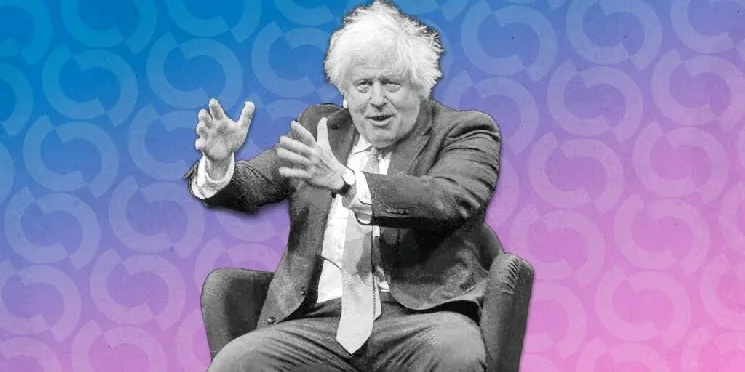
Former UK Prime Minister Boris Johnson told a room full of crypto developers at Solana's Breakpoint conference in London that he still can't see who is in charge of the world's largest cryptocurrency. "As far as I can see, nobody knows who's in charge, apart from Yakimoto Nakasori, and I don't know where to find him," Johnson said, deliberately mangling the name of Bitcoin's pseudonymous creator, Satoshi Nakamoto.
Johnson's skepticism extends to concerns about security and accountability. "If six billion got stolen from some cryptocurrency, I wouldn't know who to apply to, or how to get the money back. That's my problem," he added, highlighting his fundamental doubts about the cryptocurrency's structure.
The former prime minister was asked about a column he wrote in March for the Daily Mail, in which he called Bitcoin a "giant Ponzi scheme." This statement drew pushback from the crypto industry, including Strategy executive chairman Michael Saylor, who tweeted that Bitcoin has no issuer, promoter or guaranteed return.
Bitcoin is not a Ponzi scheme. A Ponzi requires a central operator promising returns and paying early investors with funds from later ones. Bitcoin has no issuer, no promoter, and no guaranteed return—just an open, decentralized monetary network driven by code and market demand.
Personal experience shapes views
Johnson admitted he is "not a great crypto buff" and holds little, if any, crypto himself. His skepticism was shaped by a man he met in his Oxfordshire village who had lost thousands and kept paying more in the hope of recovering his losses. "If the search for the greater fool had reached the wilds of South Oxfordshire, then probably there was something not quite right about this thing," Johnson said.
He also questioned the name itself, noting that "crypto" comes from the Greek for "hidden." "I don't think it's a good sell to tell people that this thing is concealed," he added, expressing concerns about the terminology used in the cryptocurrency space.
Blockchain support separate from Bitcoin
Johnson drew a sharp line between Bitcoin and the technology behind it. "Please don't think that my Luddite anxiety about crypto in any way means that I wish to slow down the development of blockchain, or the lead that London should rightly have in that sort of technology," he said. When it comes to blockchain and tokenizing assets, the UK has "got to be at the forefront," he added.
Moderator Gareth Jenkinson, head of multimedia at The Block, pushed back when Johnson suggested Bitcoin was valuable to drug dealers, arguing that blockchains are far more traceable than cash. Asked by Johnson who guarantees Bitcoin, Jenkinson replied: "No one has to guarantee it. That's the beauty of the protocol."
UK regulatory framework
Lord Ross Kempsell, a Conservative member of the House of Lords who previously worked for Johnson, provided context on the UK's regulatory approach. More than 8% of UK adults now hold some form of crypto asset, and institutional adoption of blockchains is growing in the City of London, though this figure has fallen from 12% in 2024 to 8% in 2025.
The UK is "on the precipice of creating a lot of regulation" for the sector, Kempsell said, pointing to the Financial Conduct Authority's work on its regulatory perimeter and the Bank of England's coming stablecoin framework. "I share Boris's anxieties about the risks," he added, but within that perimeter, "there's a lot of scope here for a high growth industry."
In June 2026, the FCA finalized its rulebook for crypto firms ahead of a mandatory regime due to take effect in late 2027. This came days after the Bank of England eased its stablecoin rules, scrapping planned individual holding caps in favor of a £40 billion issuance limit per coin. The Bank has since been handed a legal duty to foster stablecoin innovation.
Kempsell also argued that being outside the EU's Markets in Crypto-Assets (MiCA) regulation allows the UK to set its own rules for crypto. The EU itself is set to revise MiCA in 2027 to cover foreign stablecoin issuers, creating a divergent regulatory landscape between the UK and the EU.
Related

