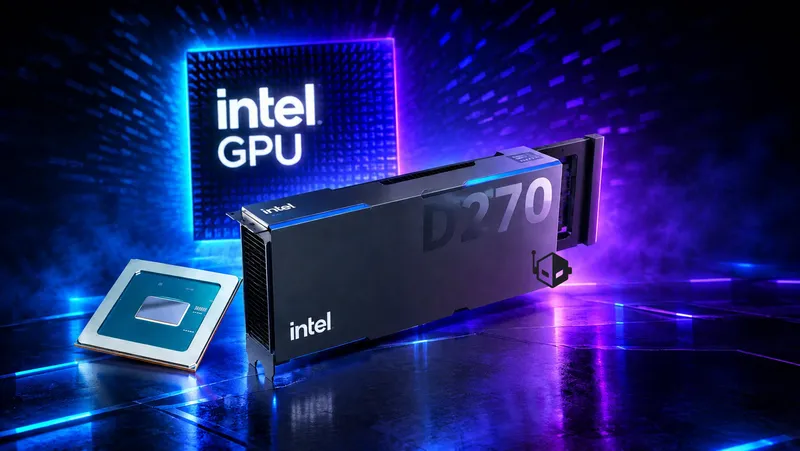
Intel Shares First Benchmarks of Its Next-Gen Crescent Island “D270” GPU, Claiming a 5.9x Throughput Over RTX PRO 6000 As Xe3P Goes Big On FP64 - Wccftech
Intel has released the first performance benchmarks for its D270 'Crescent Island' GPU, claiming up to 5.9x higher throughput than NVIDIA's RTX PRO 6000 in financial services workloads.
The D270 'Crescent Island' GPU, built on Intel's Xe3P architecture, features 32 Xe cores and 256 Xe Matrix Extensions (XMX) engines, delivering 64 FP64 fused multiply-add operations per core. This configuration provides developers with precision options ranging from FP4 to FP8 for inference alongside full-rate, native FP64 compute where mathematical accuracy is critical.
Intel disclosed the GPU specifications at SC26, revealing that the D270 can be configured with up to 480 GB of memory and an LPDDR5X subsystem. The solution will be available in various forms, from air-cooled 350W parts to liquid-cooled and dual-GPU options.
Performance Benchmarks
In tests across four financial services workloads, the D270 GPU demonstrated up to a 5.9x lead over NVIDIA's RTX PRO 6000 Blackwell Server Edition card, with an average improvement of 4.5x. Notably, Intel's solution operates at 350W, significantly less than the 600W consumed by NVIDIA's flagship product.
This means that Intel will have an edge over NVIDIA's recent Blackwell RTX PRO parts, which do not have as much FP64 compute in hand.
The GPU also showed strong performance in other areas. For seismic modeling, which requires FP32 compute across massive 3D datasets, Intel demonstrated a live showcase at SC26. In AI benchmarks, the D270 offered 29% lower latency and 1.12x throughput compared to the RTX PRO 6000.
AI Capabilities
For decision-making AI models, the D270 delivers up to 29% lower latency than NVIDIA's RTX PRO 6000 when running Drex 2.0. In LLM throughput tests, Intel's GPU achieved 1.12x the performance of the NVIDIA card on Qwen 3 30B – A3B while consuming only 350W of power.
These results, achieved on pre-production silicon, demonstrate the D270's strong capabilities for emerging agentic AI applications. The combination of high memory capacity and efficient power consumption positions Intel's GPU as a competitive option in the AI and HPC markets.
Market Position
Intel's use of LPDDR5X memory may provide an advantage over standard GDDR and premium HBM options in terms of value, efficiency, and scalability. While specific launch dates and pricing remain undisclosed, the Crescent Island GPU appears positioned as a strong contender in AI, HPC, and workstation markets.
The development represents Intel's continued push into the high-performance computing space, challenging established players like NVIDIA with architecture-specific optimizations and competitive power efficiency. The company is emphasizing the D270's native FP64 capabilities as a key differentiator in scientific and financial computing applications.
Related
