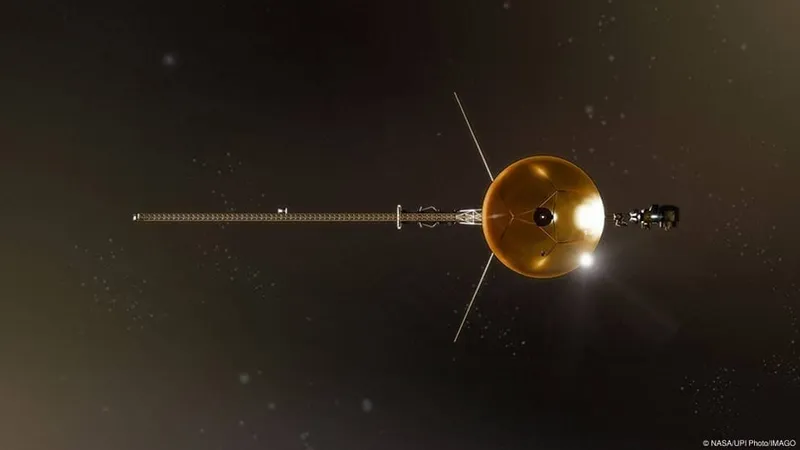
NASA's Voyager 1 reaches a light-day away from Earth
NASA's Voyager 1 spacecraft has traveled a light-day from Earth, covering the distance light travels in 24 hours, which took the spacecraft 49 years, two months and 11 days.
The spacecraft, launched almost half a century ago, reached this milestone on November 18, 2026, at 11:16 a.m. Central European Time. Voyager 1 has been traveling at an incredible speed of 61,000 km/h (38,000 mph) since its launch.
A light-day is approximately 26 billion kilometers (or around 16 billion miles) - the distance light covers in 24 hours. This means light does in one day what it took Voyager 1 nearly 50 years to accomplish.
Rare planetary alignment
When Voyager 1 launched, it took advantage of a rare planetary alignment that occurs only once every 176 years. This alignment involved Jupiter, Saturn, Uranus and Neptune, which scientists wanted to investigate.
After completing its original mission, Voyager 1 used Jupiter and Saturn to perform a gravitational slingshot maneuver. By flying close to these massive planets, the spacecraft was pulled and accelerated by their gravity, swinging around at a higher velocity than before.
Interstellar journey
If you want to say 'hello' to Voyager, you send your message and then you go home and you wait two days before you finally get a response.
In the vacuum of space, nothing slows Voyager 1 down. On Valentine's Day 1990, from beyond Neptune, the spacecraft took the only portrait of the solar system from the outside ever made by a spacecraft. In 2012, it became the first human-made object to reach interstellar space.
Related
