Google Finds Hackers Using AI Agents to Build and Run Exploits From Software Patches
Google has discovered threat actors deploying autonomous AI frameworks to automate cyber attacks and rapidly weaponize software vulnerabilities, marking a significant shift in cyber warfare tactics.
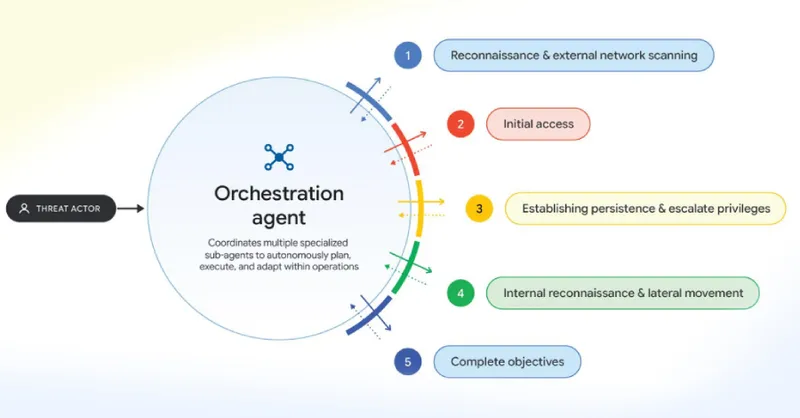
Google has revealed that adversarial use of artificial intelligence has evolved beyond manual prompting to deploying autonomous multi-agent offensive frameworks. These frameworks, including ARTEX, CAIRN, CyberStrikeAI, and PentAGI, enable threat actors to execute multi-stage intrusions at greater operational velocity, fundamentally changing how cyber attacks are conducted.
Automated Exploitation
Threat actors are leveraging large language models (LLMs) and agentic frameworks to automate the reverse engineering of patches through differential analysis. This allows them to rapidly weaponize newly disclosed vulnerabilities, as demonstrated with the PaperCut NG/MF flaws discovered in September 2026.
New Attack Vectors
The adoption of these AI frameworks represents a paradigm shift where cyber attacks occur at machine speed, allowing operations to be scaled significantly by chaining together varied attack paths. Google observed financially motivated and suspected espionage actors aligned with China experimenting with these frameworks.
Other tools being misused include ZeroHollow, an inference service for exploit development and LLM routing, and Agent Zero, an open-source framework featuring autonomous code execution and dynamic tool generation. Threat actors are also targeting AI infrastructure through LLMjacking attacks, stealing credentials and cloud resources from compromised enterprise environments.
Phishing Evolution
The emergence of open-source frameworks has lowered the barrier to entry, enabling bad actors to easily integrate new exploits and autonomously scale attacks. A Chinese-language phishing platform called Jieyou has integrated an LLM chatbot assistant that allows customers to configure phishing panels using natural language commands, even without technical expertise.
Related
