NvRoot bug in NVIDIA drivers hands root to anyone renting a GPU - Pasquale Pillitteri
A critical vulnerability in NVIDIA Linux drivers allows unprivileged users to gain root privileges through GPU memory manipulation, affecting particularly those who rent GPU compute time.
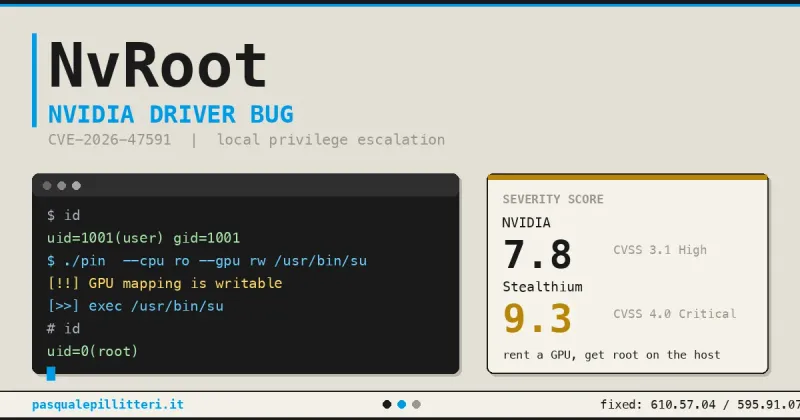
The NvRoot vulnerability (CVE-2026-47591) exists in NVIDIA's Linux driver software, allowing any user with access to a GPU to escalate privileges to root level. The flaw lets attackers write to files they should only be able to read by manipulating GPU memory permissions. NVIDIA released a fix on August 3, 2026, but many driver branches remain vulnerable.
Security firm Stealthium discovered the vulnerability while monitoring NVIDIA drivers and CUDA runtime from within the kernel. The issue particularly affects providers of neocloud services—companies that rent GPU compute time by the hour—where multiple customers share physical machines. With ongoing GPU shortages, this usage model has become essential for many companies needing AI compute resources.
How the attack works
The attack requires only a regular account on the machine and the ability to open the /dev/nvidiactl device, which any CUDA program can do. With a single driver call, the user gains write access from the GPU to an in-memory copy of a system file. The natural target is a setuid program like /usr/bin/su, which starts with root privileges regardless of who launches it.
The file on disk never changes, so file integrity checks see nothing move. The kernel reads the original setuid bit from disk and grants root privileges, but it executes the copy in memory, already tampered with.
Permission oversight
The vulnerability stems from a flaw in how the driver handles two separate permissions when a process requests memory pinning for GPU access. One permission covers what the CPU can do with the memory, while the other covers what the GPU can do. Vulnerable drivers derive the page's real permissions from the CPU field alone and never check the GPU permission field.
This means a request with CPU read-only and GPU write permissions is accepted as-is. The pages are pinned without write intent, but the GPU mapping is marked writable, creating a direct write channel into the file. NVIDIA's fix ties these two permission fields together, ensuring the GPU remains read-only whenever the CPU is.
Impact on rented GPUs
The vulnerability poses the greatest risk to multi-tenant environments like GPU rental services. When a tenant compromises the GPU, the tampered binary affects both the host machine and all other tenants sharing the physical hardware. This means attackers could access model weights and live inference data from other customers.
Severity assessments vary between NVIDIA and Stealthium. NVIDIA rates the flaw 7.8 out of 10 (high under CVSS 3.1), while Ubuntu classifies it as medium. Stealthium, however, rescores it at 9.3 out of 10 (critical under CVSS 4.0) for multi-tenant environments, arguing the hostile tenant is part of the usage model in such cases.
Patch status
NVIDIA's fix is included in driver versions 610.57.04, 595.91.07, 580.178.04, and 615.71.09. According to Stealthium, all releases of the R590, R575, and R570 branches remain unpatched, along with all of R565 and earlier. Users on these branches must upgrade to a fixed version rather than waiting for patches.
No workaround exists for the vulnerability since the flaw sits in the core logic of how the driver derives permissions. Any process able to open /dev/nvidiactl can reach the faulty code. The vulnerability has existed since at least May 2022, making it a four-year-old flaw that affected every NVIDIA driver build until the August fix.
Related
