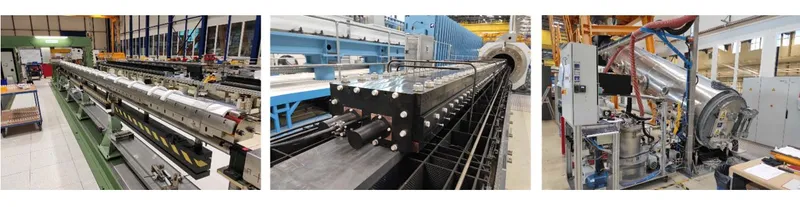
New Super Magnets Turbocharge the Large Hadron Collider
The Large Hadron Collider (LHC) is preparing for its fourth run by installing new superconducting magnets that will significantly increase its collision rate.
The LHC has completed its third run, which lasted from 2022 to July 2026, and is now in its third shutdown phase for upgrades.
The most significant upgrade is the high-luminosity (HL) project, which introduces more powerful superconducting magnets to boost the collider's performance.
These new magnets are made of niobium-tin (Nb3Sn) and are capable of achieving a field strength of nearly 12 Tesla, compared to the previous 8.3 Tesla from niobium-titanium (NbTi) magnets.
The new material is brittle in its superconducting phase, requiring a complex manufacturing process that involves winding, a heat treatment under an inert atmosphere, and impregnation with epoxy resin.
The process is difficult, with potential issues ranging from contamination to incorrect winding and handling glitches, but the team has successfully debugged the tooling and created coils that passed all tests.
If the project proceeds as planned, the LHC will enter its fourth run as the HL-LHC by 2030, with a luminosity increase of 5-7.5 times.
This increase will mean far more collisions should occur within any timespan, producing much more data in less time.
Related
