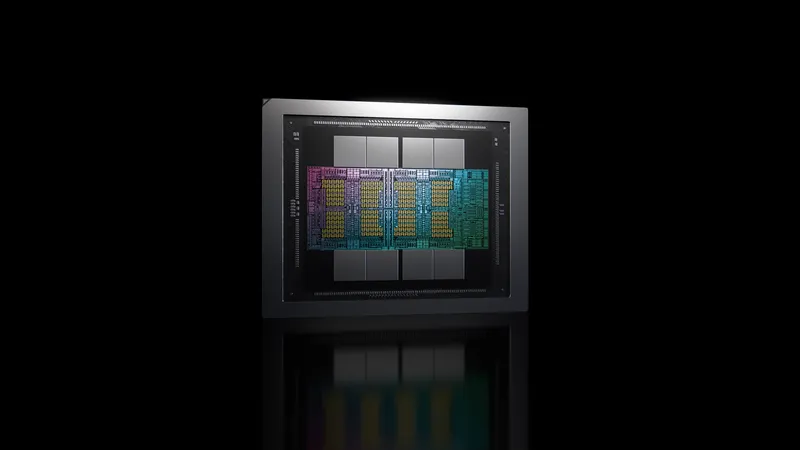
NVIDIA Announces Rubin HPC — A New GPU to Accelerate Agents for Science, Engineering and Analytics - NVIDIA Blog
NVIDIA has announced the Rubin HPC GPU at SC26, designed to accelerate simulation and data processing for science, engineering and analytics workflows.
As agents help scientists and engineers explore more candidate materials, molecules and designs, they rely on simulations to test those ideas and guide their next steps. Rubin HPC will accelerate those simulations, shortening the path from exploration to scientific discovery and industrial design.
Record-Breaking Performance
The Rubin HPC GPU features a record number of CUDA cores — more than 50,000 on a single GPU — as well as sparse data acceleration capability that keeps those cores fed with data. It also accelerates GPU-to-GPU connectivity with seventh-generation NVIDIA NVLink interconnect technology.
Balanced Design for Science
Scientific computing workloads typically involve applications reaching into immense datasets, gathering scattered values, calculating results and repeating this on a large scale. Rubin HPC offers a balanced design, scaling data movement and compute together rather than increasing compute alone.
This balance optimizes the GPU for scientific computing, keeping the record number of CUDA cores supplied with data so they spend time computing rather than waiting. This accelerates recurring patterns in simulation workloads from sparse matrix operations to stencil computations.
NVIDIA CUDA-X libraries offer optimized implementations of complex algorithms for agents to use. When used with Rubin HPC, these libraries can provide the fastest path to reasoning outcomes, shortening the loop of hypothesis, simulation and refinement.
Related
