Carnegie Mellon’s OATs give household objects Tamagotchi-style AI faces that sulk when ignored - eGamers.io
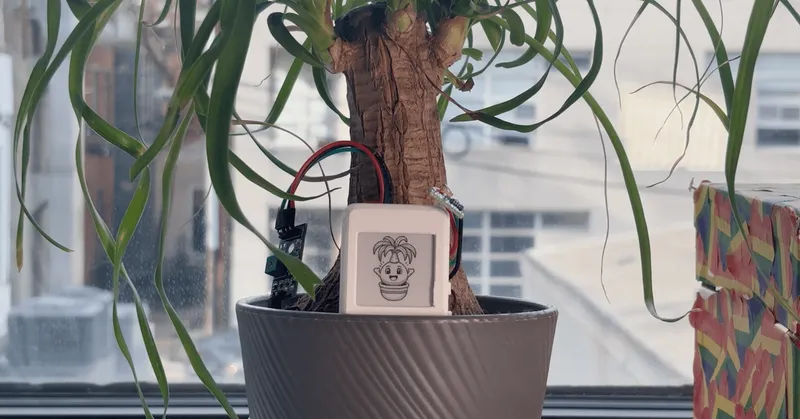
A houseplant can now show it needs water through a $20 module called an OAT that displays a sad face until watered, created by Carnegie Mellon PhD student Daehwa Kim.
A houseplant has no way to say it needs water. A $20 module attached to its pot does: it shows a small sad face on an E Ink screen until someone fetches the watering can, and the face brightens once the soil gets wet. These modules are called OATs, which stands for Object Agent Twins, created by Daehwa Kim, a fifth-year PhD student in Carnegie Mellon's Future Interfaces Group.
In early November, Kim showcased the project at the ACM Symposium on User Interface Software and Technology in Detroit, where she received two Honorable Mention awards. The inspiration comes from 90s Tamagotchi toys, bringing the joy of caring from virtual pets to physical objects in our homes.
Tamagotchi for household items
Kim's project aims to shift AI interactions away from smartphones and into our living spaces. "We bring this joy of caring from virtual to physical objects," she said. The modules can be attached to various objects, like a skateboard that shows a sad face when unused, which turns happy when ridden.
These kinds of inanimate objects can be more expressive
Three usage patterns emerge
Through testing, Kim identified three primary use cases for OATs. The first answers "Am I being used?" - like a coffee machine's avatar that gets excited when grinding beans. The second alerts people to nearby objects, such as warning about toxic fumes from a 3D printer. The third tracks habits, like motivating exercise through a dumbbell's AI pet.
Technical limitations
Each OAT contains an E Ink display connected to sensors measuring moisture, temperature, humidity, light, occupancy and motion. The main module costs around $20, with users setting it up through a web portal and choosing from sprites generated by Google Gemini's Nano Banana service.
The main drawback is battery life - OATs run for 3-4 days on a single charge, dropping to one day when using the sound sensor. This limitation has kept the project as a proof of concept rather than a commercial product, though Kim has considered selling OATs kits online.
Debate over AI anthropomorphism
I feel like in the future of computing, we will have more of a relationship with AI, but we should definitely be careful not to abuse this.
The project sparked discussion about giving AI human-like traits. Kim acknowledges this concern, noting that while anthropomorphism can help change behaviors, we should be careful not to abuse it. OATs are restricted to expressive emotions on E Ink displays with no other interactions to prevent over-attachment.
Related
