High-Speed Trader Graviton Now Earns More in Singapore Than in India
Graviton Research Capital's Singapore unit has overtaken its Indian headquarters in annual profit, a shift driven by a 166% surge in the Asian market.
Graviton Research Capital has become the first Indian quantitative trading venture to surpass $1 billion in valuation, a milestone driven by a massive pivot of its profit engine to Singapore.
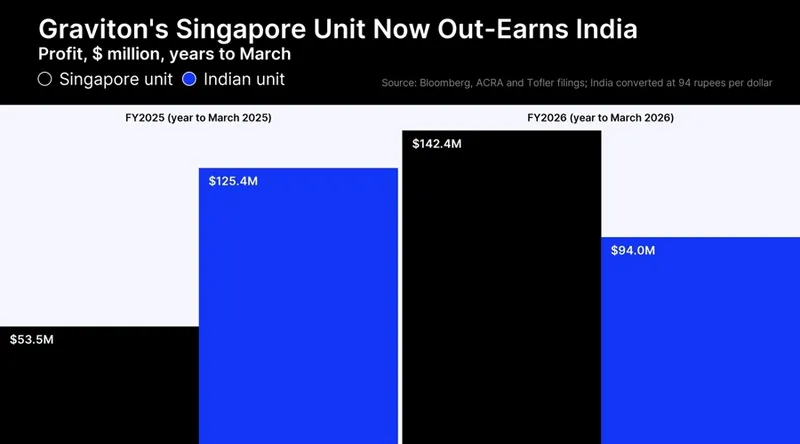
The firm's Singapore entity, which it describes as its global business, nearly tripled its annual profit to $142.4 million in the year to March 2026. This represents a 166% increase, while its home market in India saw profits fall by 25%.
The Singapore unit also more than doubled its revenue to $239.4 million, with profit reaching about 59% of that total. This performance has now eclipsed the profit generated by the Indian unit, which was valued at approximately $94 million at current exchange rates.
The shift has been so significant that it has lifted the Gurugram-based firm's overall valuation by a third, to about $1.46 billion. This new valuation places co-founders Nishil Gupta and Ankit Gupta, both 39, on the Bloomberg Billionaires Index with an estimated net worth of about $1 billion each.
"Our Singapore entity's growth reflects the strong momentum in our global business," a Graviton spokesperson said in an email to Bloomberg.
Market Shifts and Competition
The co-founders, who are not related and met at the Indian Institute of Technology in New Delhi, founded the firm in 2014. Nishil Gupta, a former vice president at WorldQuant, focuses on model design and risk, while Ankit Gupta runs technology and systems.
Graviton is actively expanding its workforce, hiring for roles in Singapore, Amsterdam, and India. It has recently advertised for quantitative researchers graduating in 2027 to work in these locations, and two months ago named Adam Celentano chief operating officer in the US.
The firm attributes the decline in its Indian operations to headwinds in the local trading environment. These include regulatory changes and increased competition from established global players.
India reined in its options market after retail losses mounted, and the Securities and Exchange Board of India (SEBI) found that nearly 91% of individual futures and options traders lost money in the year to March 2025. The government also raised the securities transaction tax on futures and options from April 1, 2026.
Meanwhile, major market makers like Virtu Financial and Citadel Securities have expanded their presence in India. Organic traffic from India to retail broker websites fell 47.1% quarter on quarter in Q3 2026, indicating a cooling of retail interest.
The firm's spokesperson tied the tougher environment to regulation and competition. Algorithmic firms now capture 99% of the profit earned by proprietary traders and foreign investors in India.
Related

