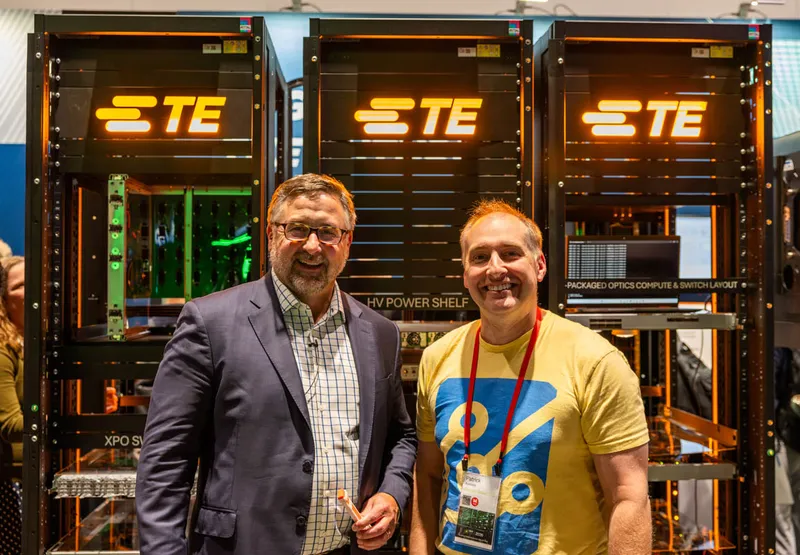
TE Connectivity at OCP Summit 2026 The Interview
TE Connectivity announced its new 448G connectivity standard at the 2026 OCP Global Summit, developed in partnership with NVIDIA and Cisco to address bandwidth challenges in AI infrastructure.
At the 2026 OCP Global Summit, TE Connectivity unveiled its new 448G connectivity standard, developed in partnership with NVIDIA and Cisco. The announcement came just days after the event began, with the company showcasing a system-level approach to address the growing challenges in AI infrastructure.
Brian Payne, Vice President of Product Management for TE Connectivity's Digital Data Networks (DDN) business, explained that the new standard balances signal integrity, power delivery, and form factor. The company has experienced massive growth over the last three years while building out AI infrastructure, with DDN becoming one of its most exciting divisions.
448G Connectivity Innovation
TE Connectivity's 448G solution features a similar form factor to current QSFP standards but introduces unique design elements. The transceiver slides in with a unique compression method that separates power delivery and signal integrity, allowing for stronger signal performance and future integration of cold plate liquid cooling systems.
The company has been part of OCP since 2017 and has made significant contributions to the organization's standards. Payne emphasized that TE's approach considers the entire system from chip to switch, with innovations in near-chip packaging, optics, and cabling.
Copper and Optical Solutions
TE Connectivity highlighted breakthroughs in copper backplane and midplane technologies, which separate compute from GPU components while maintaining connectivity. The company is one of the few capable of producing these highly engineered solutions at massive volumes.
Despite copper's continued prevalence, the company is also heavily investing in optical technologies through its acquisition of RAM Photonics earlier in 2026. Payne explained that while copper remains state-of-the-art, the increasing number of communication lanes makes optics increasingly necessary for future deployments.
The company has also made significant progress in co-packaged optics, developing connectors that can be serviced within the chip package—a capability that wasn't feasible just five years ago. This innovation addresses critical serviceability challenges at scale.
Power Delivery Innovation
To address the massive power requirements of modern AI infrastructure, TE Connectivity introduced its sidecar power rack design. This separate rack contains full power distribution and cooling capabilities, as traditional racks can no longer accommodate the necessary power density.
The system-level approach includes optical interconnect racks, sidecar power racks, and copper IT racks working together to solve the complex challenges of scaling AI infrastructure. Payne emphasized that TE's focus extends beyond individual components to complete system solutions.
As AI workloads continue to grow, TE Connectivity's innovations in connectivity, materials science, and power delivery aim to support the industry's massive scale requirements while maintaining performance and reliability.
Related
