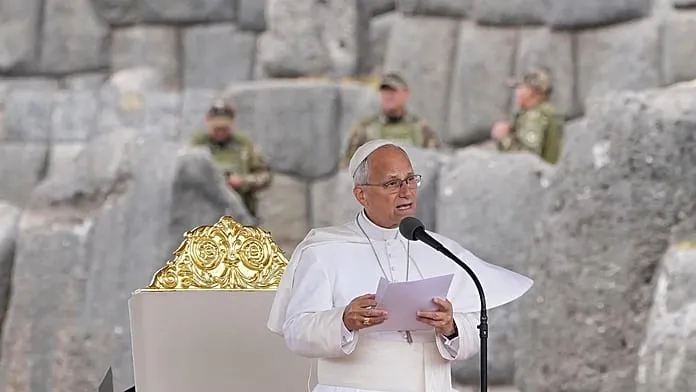
Pope Leo XIV in visit to Peruvian rainforest demands justice for slain Amazon defenders
Pope Leo XIV travelled into the Peruvian rainforest to demand justice for environmental defenders killed while protecting the Amazon and backed Indigenous communities fighting illegal mining and logging.
On the penultimate day of his South American tour, Leo travelled into the Peruvian rainforest and echoed a central teaching of Pope Francis: that care for the most vulnerable and care for creation cannot be separated.
The Pope told Indigenous representatives and missionaries gathered on the Ucayali River in Pucallpa that he had come to support them in their search for justice and peace.
He referred to the 57 murders of environmental defenders that campaign groups estimate took place between 2010 and 2024.
Call for a different model of development
Drawing on his years as a bishop in Peru and on Francis’ constant preaching on the environment and Indigenous peoples, Leo used the encounter and a Mass that followed to call for an economic model that respects the Earth.
He criticised the "irresponsible exploitation" practised by outsiders and said that "very little has been done" to stop the destruction.
“The cry of the earth and the cry of the poor are inseparable,” he told Indigenous representatives and missionaries gathered on the Ucayali River in Pucallpa.
He said that in the face of these evils, they should not bury the Lord’s gifts, for he gives them the strength to repair and heal the suffering caused by an insatiable thirst for domination.
Illegal mining and coca production are also driving deforestation and encroaching on Indigenous territories, putting ancestral lands at risk and exposing communities to violence and organised crime.
On Saturday, Peruvian police reported three operations against illegal mining in Madre de Dios, one of the country’s most biodiverse regions, destroying equipment, rafts and engines valued at €3.8 million ($4.1 million).
Justice for slain leaders
In Peru, most killings of environmental defenders go unpunished, and convictions are rare.
In 2025, the courts upheld 28-year prison sentences for four timber merchants over the murder of four Indigenous people who opposed logging, after a trial lasting a decade.
The most recent conviction came in the case of Kichwa leader Quinto Inuma Alvarado, who was ambushed and killed by hitmen on a river in the San Martín region in 2023.
The court found that Inuma had filed a complaint against the defendants to stop deforestation and other crimes, including drug trafficking, and that they plotted his death because he had spoken out.
Sexual violence against Indigenous schoolgirls
Leo also addressed a sharp rise in sexual violence against Awajún and Wampis schoolgirls in Condorcanqui province, in the northern Amazon, and condemned the "complicity", "impunity" and "corruption" surrounding it.
The Awajún and Wampis Women’s Council, Comuawuy, has recorded 370 cases of sexual violence in the province between January and July alone.
After persistent demands from women’s groups, specialised prosecutors’ offices were created and the government launched a prevention plan.
In January, the Ministry of Women and Vulnerable Populations announced a 32-year prison sentence for a man accused of sexually abusing a 14-year-old girl.
Pontiff's stamina on tour
The visit to Cusco, 3,400 metres (more than 11,000 feet) above sea level, tested Leo’s stamina as he continues his recovering from lung cancer surgery last month.
The 71-year-old has appeared unfazed by the three-nation trip, the longest of his pontificate, which began on 6 November.
While others aboard the papal plane have fallen ill, Leo has shown no sign of fatigue and has seemed energised, particularly by the days spent seeing old friends in his former diocese of Chiclayo.
The Pope mostly sat in the chair of his popemobile during part of the ride around Cusco, but it wasn’t clear if that was to preserve his energy or to steady himself on the uneven streets.
Related
