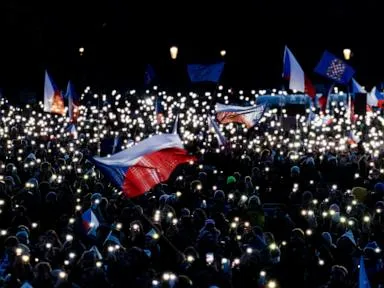
Czechs gather in big numbers to reject government's plan to overhaul funding of public media
Hundreds of thousands of people rallied in Prague on Sunday to reject a government plan to overhaul the funding of public broadcasters, a move that critics say would erode media independence.
The massive protest took place at the capital's Letná Park, a historic site where huge crowds gathered during the 1989 Velvet Revolution, which ended more than 40 years of communist rule in the country.
The rally, just two days before the anniversary of the 1989 protests, drew an estimated 350,000 people, said Mikuláš Minář, the lead organizer from the Million Moments for Democracy group.
“It's just a beginning.”
Government plan and public reaction
Under the plan, the country’s public radio and television broadcasters would be financed from the state budget, replacing the existing system of regular fees paid by individuals, households and businesses.
The broadcasters would receive about 15% less money than they do now, which could lead to layoffs, limited production and program cancellations.
Critics say the overhaul would give the three-party coalition the means to take control of the media, similar to what populist governments did in Slovakia under Prime Minister Robert Fico and in Hungary, before former Prime Minister Viktor Orbán was ousted from power in April.
One of the protesters, singer Šarka Dumišincová, said that for her “the media represent freedom. And the fact that someone here is trying to control that freedom is unacceptable to me.”
The ruling coalition unexpectedly moved ahead with the plan in the lower house of Parliament on Oct. 24. Its lawmakers limited the opposition's speaking time before voting at 4:36 a.m. to advance the bill through the first of three parliamentary readings.
Thousands took to the streets the following day to protest the rushed process, and public media employees went on strike on Nov. 3. The strike was backed by labor unions, universities, students, churches, artists, athletes and international media organizations, among others.
“We are here to stand up against the rule by force in the style of 4:36.”
Political context and next steps
Babiš vowed to press ahead with the plan despite the protests and denied that it would affect media freedom. He returned to power after his ANO, or YES, movement, won the country’s election last year and formed a coalition with two small political groups.
His government has been under fire from NATO allies for failing to spend enough on defense. Protesters also condemned its defense policy and demanded the resignation of the Freedom party leader, parliamentary Speaker Tomio Okamura, and Defense Minister Jaromír Zůna.
“While (Russia's President Vladimir) Putin threatens Europe, the pro-Russian (party) is systematically undermining the state’s defensive capability and endangering national security,” Minář, the main protest organizer, said.
Media freedom and the rule of law in the Czech Republic were debated Wednesday in the European Parliament. EU Justice Commissioner Michael McGrath said national legislation must ensure that funding for public service is based on transparent and objective criteria and guarantees “adequate, sustainable and predictable financial resources.”
Related
