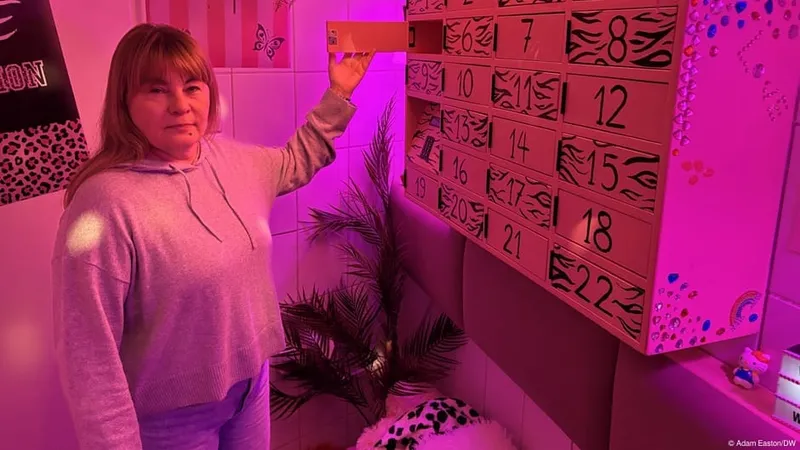
Despite restrictive abortion laws, Poland's 'Abortomat' — a locker that dispenses abortion pills — helps women who want to end a pregnancy
Women's rights activists in Poland have opened what they claim is the world's first delivery locker supplying abortion pills, in a building opposite the parliament.
The 'Abortomat' is a pink locker that dispenses mifepristone and misoprostol after a medical questionnaire is completed and a PIN code is received. Activists say it bypasses the need for a person to directly hand over the drugs, which risks a prison sentence. The device faces legal challenges from Catholic groups and political opposition ahead of next year's election.
Located in a small room behind a tasseled portiere at Abotak, Poland's first abortion center, the locker opened in late September. It contains 22 pink compartments, each holding a package with the two drugs, usually taken up to the 14th week of pregnancy.
To access the pills, a woman must first complete a medical questionnaire from the organization Women Help Women, which is then checked by a doctor. She then receives a PIN code to open her specific locker.
The mifepristone is not registered in Poland, so the drugs are ordered from abroad where they are legal. The activists at Abortion Dream Team and Abotak help women find this information and navigate the process.
Justyna Wydrzynska, an activist from the Abortion Dream Team, believes the locker does not break the law because it is a machine, not a person, that is delivering the pills. She admits she is not entirely sure of the legal outcome.
"When you walk around Poland, vending machines are everywhere. This is our culture. People in the US have Amazon, we have vending machines for everything," said Wydrzynska.
Dr. Sabrina Mana-Walasek, a reproductive rights lawyer representing Wydrzynska, said the legal environment for abortion pills is 'complicated.' She argued that as EU citizens, Polish women can order the drugs and take them if they pay for them themselves.
The ultra-Catholic legal group Ordo Iuris disagrees and has notified the prosecutor's office that the activists are committing a crime. Katarzyna Gesiak, the director of the Ordo Iuris Center for Medical Law and Bioethics, explained the group's position.
"In the case of an 'Abortomat,' the actions enabling a woman to have an abortion are theoretically performed by the woman herself using the device, but the reality is that this machine is operated by people — they send the code required to open the compartment containing abortion pills, they order and procure the pills, and they restock the compartments," said Katarzyna Gesiak.
Activists say anti-abortion groups regularly demonstrate outside Abotak, using horns and loudspeakers to generate noise and pressure the landlord. At one demonstration, a woman holding an image of the Virgin Mary told DW she believes abortion is 'the work of Satan.'
The activists help about 130 women daily in Poland. About 125 of these women use pills that cost around €75 ($83), while the remainder travel to a clinic abroad. In contrast, just 851 abortions were performed in Polish hospitals last year.
Diana, a 25-year-old Ukrainian woman living in Warsaw, used abortion pills during her sixth week of pregnancy before the 'Abortomat' started up. She got the pills using information provided by the Abortion Dream Team.
Natalia Broniarczyk, another Abortion Dream Team activist, is concerned about the rising support for right-wing parties ahead of next year's parliamentary election. She is also frustrated with the inactivity of liberals in Prime Minister Donald Tusk's coalition.
After taking office in 2023, Tusk's coalition was unable to agree on a common position and their separate bills failed to obtain parliamentary approval in 2024. The prime minister said abortion on request would not be possible during the current parliamentary term.
In October, two bills were resubmitted to the Sejm and narrowly approved. One reinstates severe irreversible fetal defects as a justification for a legal termination, which had been ruled illegal by the Constitutional Court in 2020.
The 2020 ruling led to tens of thousands of people, mostly women, taking part in street protests across the country. Lawmakers also approved a bill partially decriminalizing anyone who helps a woman terminate a pregnancy.
A recent poll by SW Research for Onet.pl found that almost 61% of respondents want President Karol Nawrocki to sign into law the bill on the fetal defect justification. Nawrocki opposes abortion, and both Wydrzynska and Broniarczyk believe he will use his power of veto to block the bills.
Related
