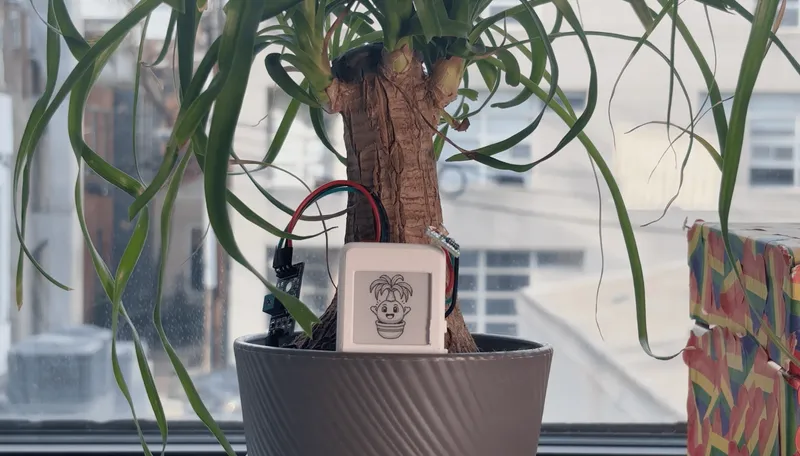
This AI Tamagotchi Turns Everyday Objects Into Needy Virtual Pets
Carnegie Mellon PhD student Daehwa Kim has created OATs (Object Agent Twins), micro-agent AI avatars on E Ink displays that pair with everyday objects, earning two Honorable Mention awards at the ACM Symposium on User Interface Software and Technology in Detroit.
OATs (Object Agent Twins) are micro-agent AI avatars displayed on tiny E Ink screens designed to pair with everyday household objects. The technology, created by Daehwa Kim, a fifth-year PhD student in Carnegie Mellon's Future Interfaces Group, was presented at the ACM Symposium on User Interface Software and Technology in Detroit in early November, where Kim earned two Honorable Mention awards.
Digital Companions
Kim's project revives the concept of Tamagotchi, the popular 90s digital pet toys, but extends it to physical objects. The system uses internal and external sensors tracking moisture, temperature, humidity, light, occupancy, and motion to determine an object's status. These sensors connect to an E Ink display showing expressive AI-generated sprites that react to the object's condition.
We bring this joy of caring from virtual to physical objects.
Practical Applications
Users can set up OATs through a web portal, naming their virtual companion and selecting which sensors to use based on the object. The system generates "Positive" and "Negative" behaviors automatically but allows customization. For example, a plant OAT might show happiness with consistent air temperature and low humidity if the plant prefers dry conditions.
The technology encourages interaction with objects in three main ways: confirming object usage (like a coffee machine avatar reacting to grinding), warning about device status (such as alerting to toxic fumes from 3D printers), and tracking personal behaviors (like motivating exercise through a dumbbell avatar).
Technical Limitations
Despite its innovative approach, OATs currently serve more as a proof of concept than a practical solution due to significant battery limitations. The system lasts only three to four days on a single charge, but when paired with a sound level sensor, that duration drops to just one day. The hardware costs approximately $20 for the main module and includes a USB-C port for charging its lithium-ion polymer battery.
Anthropomorphism Debate
The OATs project sparked discussion about anthropomorphizing AI, particularly whether giving artificial agents human-like traits and emotions is appropriate. Kim acknowledges this concern, noting that while anthropomorphism can help change behaviors, we should be careful not to abuse this connection. "I feel like in the future of computing, we will have more of a relationship with AI, but we should definitely be careful not to abuse this," she says.
This anthropomorphism trend extends beyond OATs, with companies like Anthropic using terms like "dreaming" to describe AI processes. Kim has intentionally limited OATs interactions to expressive emotions and the E Ink display to prevent excessive emotional attachment while still fostering a connection between users and their objects.
Related
