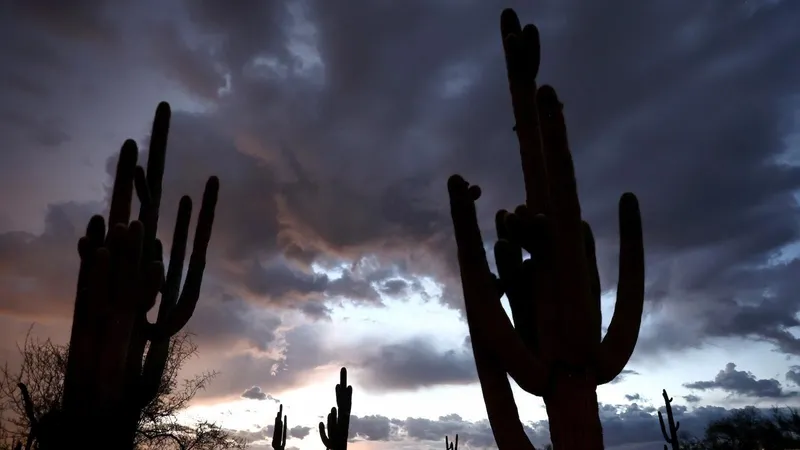
It’s Getting Too Dry for Even Cactuses to Survive
A new study published in Nature reveals that worsening droughts due to climate change could cause more than a quarter of nearly 1,000 cactus species to lose at least 80% of their habitat by 2100.
The humble cactus, long an icon of resiliency in harsh desert environments, is facing unprecedented threats from worsening droughts. A new study published in Nature reveals that despite their reputation for thriving in arid conditions, cacti are highly vulnerable to intensifying dry spells caused by climate change. Researchers modeled future scenarios with rising temperatures and prolonged droughts, finding that the majority of nearly 1,000 cactus species will lose significant habitat.
More alarmingly, over a quarter of these species could lose at least 80% of their suitable habitat by the year 2100. This challenges the common perception of cacti as nearly indestructible plants that can withstand any environmental challenge. "The public perception of cacti tends to be of these organisms that are extremely drought-adapted and are just resilient, can handle anything that you throw at them," said Michiel Pillet, a conservation ecologist at the University of South Florida and lead author of the paper.
Water Dependency
Contrary to popular belief, cacti actually require water to survive and reproduce. In the deserts of the southwestern United States, for example, they depend on seasonal monsoon rains that typically occur during July or August. While cacti have evolved adaptations like waxy skin to retain water, these adaptations only work within the climatic conditions they evolved under. "Just like other plants, they evolved under conditions that they're used to," Pillet explained. "When you take them outside of those conditions, they might not be able to handle that."
The researchers compared drought-stressed cacti to sick hospital patients dealing with both heat-related illness and dehydration. As global temperatures rise and dry spells intensify, cacti face multiple simultaneous stressors that can be fatal. "When we consider drought conditions, then it turns out that they're much, much sicker than we previously thought," Pillet said. "These results really do change the outlook of cacti, and most likely plants more broadly under climate change."
Complex Threats
The study utilized data from the citizen science platform iNaturalist, where 650,000 observations of cacti in the wild helped researchers understand how species might be responding to changing conditions. The threats aren't simply about cacti withering and dying from lack of water; the stress could be more complex, affecting different life stages and processes differently.
"Now we can move towards questions of: What life stages are most affected?" Pillet said. "Is it the adults or is it the seedlings? But also, which processes? Is it reduced growth or is it increased mortality? Or are plants failing to flower?" In the Sonoran Desert, the iconic saguaro cactus is already reproducing less frequently during prolonged droughts because they're not always flowering.
Conservation Challenges
Desert ecosystems, while appearing tough, are actually quite fragile and slow to recover from disturbances. Drought now compounds with other stressors like habitat loss and poaching, driving cactus species toward extinction. On the other end of the spectrum, rising sea levels have already caused the local extinction of the Key Largo tree cactus in Florida.
Higher nighttime temperatures pose another threat, as that's when cacti like the saguaro respire to avoid water loss. "If the nighttime temperatures are very high, they can't do it," said Rod Haenni, president of the Cactus and Succulent Society of America. "Then if you water on top of that, the plants just rot." Some species may migrate to areas with more favorable climates, similar to plants moving north in the Arctic.
Conservation efforts may include relocating cacti to botanical gardens or reintroducing them to protected areas. Governments need to protect threatened cactus habitats, though political indifference remains a barrier. "Hopefully, it'll wake people up," Haenni said. "But the problem is that a lot of the governments involved are indifferent to this. There are a lot of people in the countries who are not indifferent, but they're not running the governments."
Related
