Google turned to AMD Epyc, not its own Axion chips, to secure its first confidential TPU - TechRadar
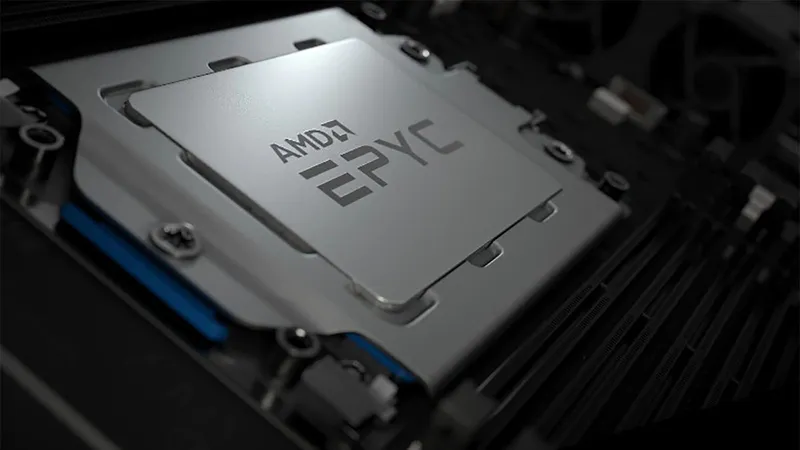
Google has launched its TPU 8tx, a confidential AI inference system that pairs Google's TPU 8t silicon with 5th Gen AMD Epyc CPUs instead of Google's own Axion processors.
The TPU 8tx, detailed alongside the dual-chip TPU 8i Max in a Google Cloud blog post, pairs Google's accelerator silicon with 5th Gen AMD Epyc CPUs. AMD also announced that Epyc forms the host foundation for what both companies call the first cloud TPU system with hardware-enforced confidential computing.
The 8tx inherits the 8t's 12.6 petaflops of FP4 compute and 216GB of HBM, but swaps in the lower-latency Boardfly network used by the 8i. Google claims up to 2x lower latency than TPU 8t with a near-zero performance penalty, targeting regulated enterprises and governments working with private data.
AMD says Epyc handles orchestration, data preparation, and the high-throughput link to the accelerators. Its Secure Encrypted Virtualization (SEV) works with the TPU to extend the protected environment out to the accelerators, checking each one's identity and security configuration before granting direct access to protected memory.
Why AMD over Axion?
Google hasn't directly explained why it passed over its own Axion CPU, unveiled in 2024 as its first data center processor. However, Google's documentation shows its supported Confidential VM configurations run entirely on AMD SEV and Intel TDX machines, with no Axion-based instances listed. The company also states that TPUs can't currently be attached to Confidential VMs.
Keeping sensitive data and model weights protected and isolated even while in active use.
Google security experts have performed deep reviews of AMD's security processor firmware, and SEV already underpins Google's Confidential VMs, Confidential GKE, Confidential Space, and confidential Spark and Dataflow services. This established x86 security architecture likely influenced the decision.
Strategic implications
ServeTheHome reported Google chose Turin to match the TPU 8t's PCIe Gen5 x16 interface, noting that a Gen6 host such as Venice would add no accelerator bandwidth. The decision aligns with Google's 2027 qualification schedule, as Venice is AMD's 2nm flagship while the 8tx uses a chip family from October 2024.
Mark Lohmeyer, who runs AI and computing infrastructure at Google Cloud, told reporters that select customers will be able to deploy the 8tx in their own data centers. He emphasized that the technology lowers the risk of physical operators reaching sensitive data, even in third-party facilities.
When Google needed a host CPU to stake its first confidential TPU on, it picked AMD over its own chip.
The move revives August rumors that Google was working with AMD on a TPU project, possibly with CPU cores on the same package. While the 8tx doesn't confirm this as its Epyc chips sit in separate sockets, it suggests potential future collaborations between the companies.
The news saw AMD's stock close at $508.58 on November 9, up 13.26%, after trading as high as $515.18 on more than twice its recent average volume. Oppenheimer's Rick Schafer upgraded AMD to Outperform with a $600 target, calling its server and data center success "undeniable."
Related
