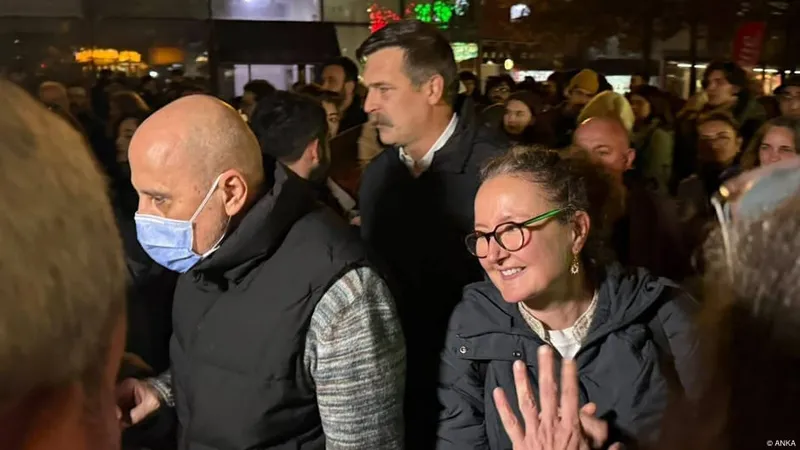
Espionage accusations are among the tactics the Erdogan government uses to put pressure on its critics
Turkish police arrested Yonca Verdioglu Sik, project coordinator for the Heinrich Böll Foundation, on espionage charges that were never substantiated during interrogation.
When police officers appeared at her home in Istanbul last Wednesday evening, Yonca Verdioglu Sik was surprised — even more so when they took her in for questioning. Her lawyer says she was accused of political and military espionage. According to transcripts of the interrogation that were published later, Verdioglu Sik was never asked any questions about espionage. Instead the public prosecutor's office appeared to be more interested in the activities of her German employer, the Heinrich Böll Foundation.
For 18 years, Verdioglu Sik, who was born and raised in Germany, has been the foundation's project coordinator. In her role, she organizes projects that focus on democracy and the rights of women, minorities and LGBTQ+ people. During the interrogation, transfers of money from the foundation into her bank account were discussed. Verdioglu Sik found out that she was now also subject to a travel ban.
Pressure on politicians
Verdioglu Sik was eventually released, but her arrest caused outrage among critics of the Turkish government. She is married to investigative journalist and member of parliament, Ahmet Sik. He belongs to the left-wing Workers' Party of Turkey, or TIP, and is known as one of the harshest critics of the current government.
Sik has recently been looking into a stock market scandal, which allegedly benefited members of the ruling Justice and Development Party, or AKP, headed by Turkish President Recep Tayyip Erdogan, and associates. Opposition critics drew a clear conclusion: As a member of parliament, Sik has parliamentary immunity. So instead, the justice system is putting pressure on him through his wife.
If you take away a state's law, what is left is no longer called a state, but a gang.
Diplomatic disputes
Verdioglu Sik's arrest is not the first such case in Turkey. Ever since the attempted coup against the Erdogan government in 2016, accusations of espionage have been leveled at a wide variety of groups in Turkey: journalists, opposition figures and human rights activists as well as employees of foreign embassies and staff of foreign institutions like nongovernmental organizations and foundations.
Such accusations have often been followed by acquittals or convictions for other offenses, albeit sometimes years later. But what the many instances have in common is what's known as a "chilling effect." Any investigation can mean lengthy pre-trial detention, reputational and professional damage and even social isolation.
In 2015, for example, Can Dundar and Erdem Gul, both senior journalists at the opposition daily Cumhuriyet, were accused of espionage after reporting that Turkey had tried to ship arms to rebels fighting the Syrian government. Dundar now lives in exile in Berlin. In 2017, Erdogan said that reporter Deniz Yücel, then working for German newspaper Die Welt, was a "German agent." That led to a serious diplomatic crisis between Berlin and Ankara.
Hostage diplomacy
Hakki Tas, a research fellow and expert on Turkey at the German Institute for Global and Area Studies, said the number of such cases have been increasing over the past few years. "What foreigners or employees of foreign institutions have experienced in recent years is a continuation of this pattern," Tas told DW.
Media outlets and NGOs critical of the government have faced investigations, trials and other sorts of state sanctions for years. The ruling AKP party has also brought in its own version of a so-called "foreign agent law." These sorts of espionage cases serve both a domestic and foreign policy function, Tas said.
In terms of foreign policy, the cases also show other countries that there are limits to their activities inside Turkey. These kinds of accusations seem to become more frequent when there's some sort of foreign policy tension. It can also serve as a kind of "hostage diplomacy," Tas said. The case of US pastor Andrew Brunson is a good example. After his arrest, the Turkish government proposed a trade with the Americans, wanting to exchange Turkish preacher Fethullah Gulen, who lived in the US and who the Turkish government blamed for the 2016 coup attempt.
Related
