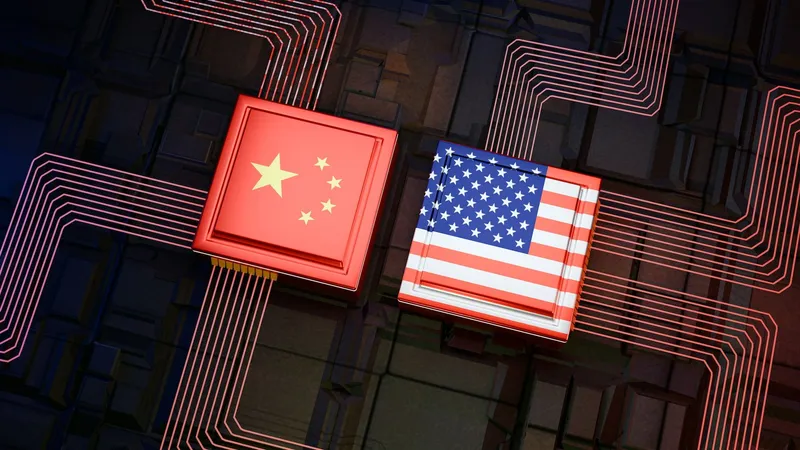
Researchers allege DeepSeek, Kimi, and other Chinese AI models were trained using banned Nvidia Blackwell GPUs
Researchers from UnemploymentLabs allege that Chinese AI models DeepSeek V4, Kimi K3.1, MiniMax-M3, and Ling-3.1-Flash were trained using Nvidia Blackwell GPUs, which are subject to U.S. export controls.
The U.S. has imposed strict trade controls to prevent the export of high-end AI accelerator chips, such as Nvidia's Blackwell series, to China. Despite these measures, it has long been suspected that the advanced silicon finds its way into the country. A new report from independent research group UnemploymentLabs claims to have strong evidence that several Chinese AI models were trained on these restricted chips.
The researchers analyzed the statistical distribution of model weights from open-weight Chinese AI models, including DeepSeek V4, Kimi K3.1, MiniMax-M3, and Ling-3.1-Flash. They found a high correlation between these models and the specific hardware used for their training.
The scientists are careful to hedge their findings, noting that while their math checks out, it does not reveal where the chips were, how they were accessed, or prove that export controls were broken.
The group developed a novel 'fingerprinting' technique that relies on the unique characteristics of different GPU families. Different AI accelerator families have unique counts of shader modules (SMs), which are analogous to CPU cores. Nvidia's Hopper chips have 132, Blackwell B series have 148, and Blackwell GBs come with 152.
The researchers' method is based on the initialization of model weights, a process that uses a pseudo-random number generator called cuRAND. For large weight sets, the thread count per SM is set to 2,048 for both Blackwell and Hopper silicon. This specific configuration creates a unique statistical signature.
By repeating a facsimile of this initialization process on the same hardware and software stack, the researchers were able to match their final statistical distribution of weight values precisely to that of the Chinese models. Changing the SM and thread counts caused the correlation to break down completely.
This technique allowed the researchers to identify the family of Blackwell/Hopper chips used for each model and to estimate the number of cards involved. However, they cannot pinpoint the exact variation of the card, as the analysis is linked to the initialization layout counts alone, not to other distinguishing characteristics like VRAM capacity or memory bandwidth.
The researchers also considered the possibility that other silicon, such as AMD's MI300X, could be configured to mimic the same SM and thread counts. They ruled this out for DeepSeek V4 by analyzing the actual weight values themselves, finding that AMD cards did not produce the same pattern.
The findings come at a time when Nvidia's grip on the AI market is tightening, and U.S. companies are navigating a complex regulatory landscape. It is not currently illegal for Chinese companies to rent Blackwell hardware abroad, and U.S. companies are not strictly prohibited from doing so, as evidenced by the recent Tencent-Oracle deal.
Related
