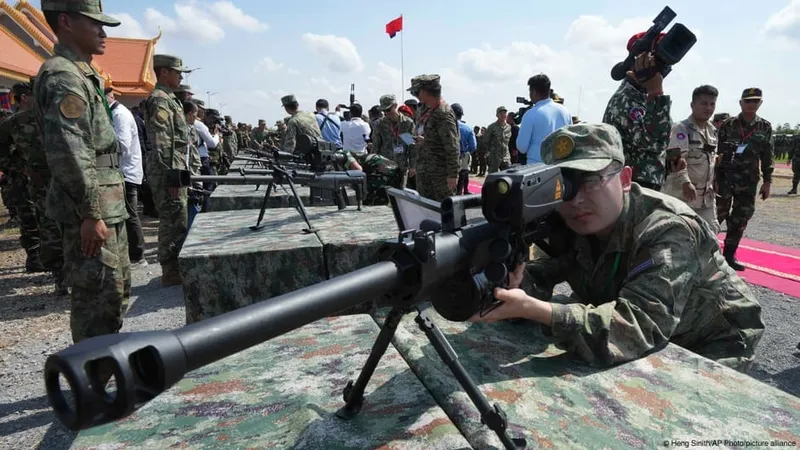
New facilities in Laos and Cambodia: Is China expanding its military presence in Southeast Asia?
China has opened a new joint military training center in Laos and expanded its footprint at Cambodia's Ream naval base, raising questions about growing military influence in the region.
In early November, China's Foreign Minister Wang Yi hosted counterparts from Laos, Cambodia, Vietnam, Thailand and Myanmar in Beijing, where the six nations agreed to closer economic and security cooperation. This diplomatic engagement follows China's establishment of new military facilities in Southeast Asia, signaling Beijing's growing strategic influence beyond trade and infrastructure.
At the end of September, China and Laos opened a joint military support and training center north of Vientiane, with China stating that Laotian air force pilots will be trained at the Ban Keun airfield. Earlier in 2025, China expanded its presence at Cambodia's Ream naval base on the Gulf of Thailand, using the facility for logistics and training while restricting access for other navies to separate quays.
Strategic implications
These developments raise significant questions about China's military objectives in the region. It remains to be seen how this will change China's military access to Southeast Asia, says Marco Bünte, a professor of Asian politics at the University Erlangen Nuremberg in Germany. If that proves correct, China would gain strategic depth in mainland Southeast Asia and better military access to the South China Sea.
China has significantly expanded its economic influence in Southeast Asia through projects like the China-Laos railway, though Laos remains heavily indebted to Beijing. Bünte notes that Laos and Cambodia have been close military partners of China for some time, with the new facilities representing deeper cooperation.
Military capabilities
While China emphasizes training Laotian pilots at Ban Keun, Laos possesses limited military assets—only three light combat aircraft from Russia's Yakovlev works and four K-8 Chinese trainer aircraft. Satellite images show eight K-8s at the base, though their permanent presence remains unclear. The runway's 2,000-meter length also limits its use for large Chinese bombers, which typically require 3,000 meters.
Regional reactions
Surrounding countries are responding differently to China's growing influence. Vietnam and the Philippines, which have territorial disputes with China in the South China Sea, are watching developments closely. Vietnam has historical military ties to Laos and has emphasized that any military cooperation must serve peace and stability, referencing the ASEAN Treaty.
Other Southeast Asian nations are hedging their bets, expanding relations with China while maintaining ties with the US and Western nations. Overall, these states try to keep as many options open as possible, Bünte notes. China maintains its activities are "not against third parties," though Bünte describes the current moves as "individual steps" that could potentially lead to broader military alliances in the future.
Fuhrmann suggests Western nations should help strengthen smaller countries in the region through tangible contributions rather than warnings. "Ultimately, a counterweight can only be achieved through tangible contributions, not through warnings or lectures from Europe," he states. The developments come as China continues to pursue its gray zone warfare tactics in the Pacific, testing regional responses without triggering direct conflict.
Related
