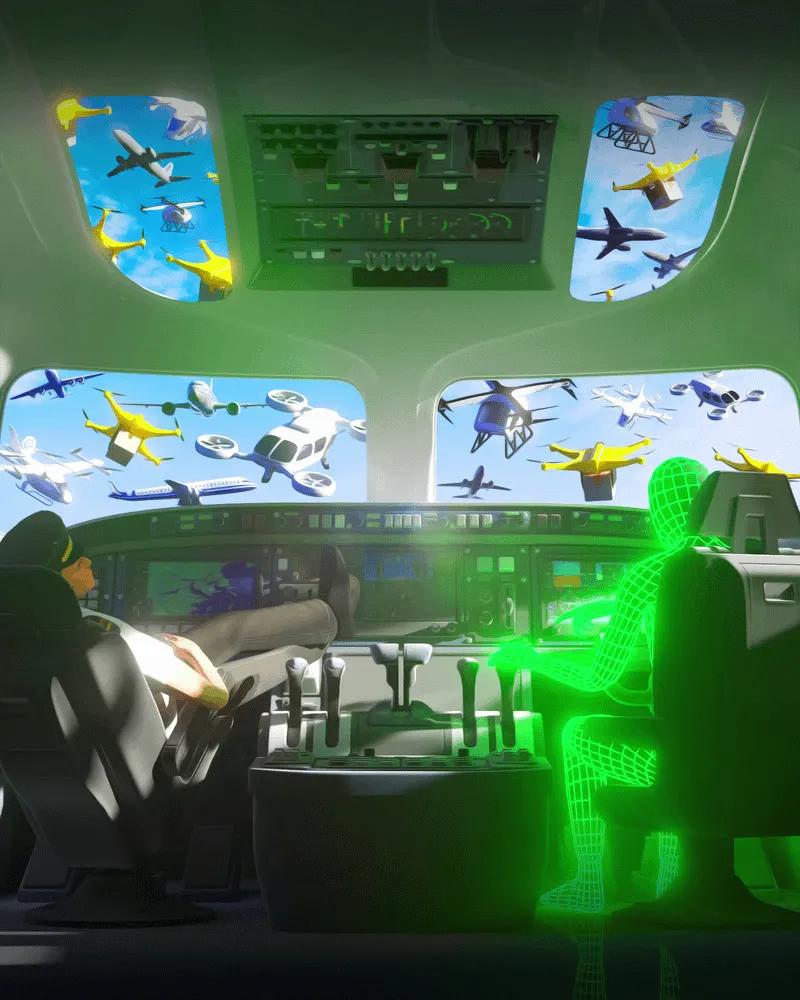
No Pilots. Few Air Traffic Controllers. What Could Go Wrong?
On September 27, US Transportation Secretary Sean Duffy introduced 'SMART,' a new AI-infused air traffic management system, but three weeks later, a national groundstop on Friday the 13th threw airline schedules into chaos.
The FAA quickly announced there was no evidence of a cyberattack or that SMART caused the communications failure, but when asked if AI failure could be ruled out, Secretary Mullin stated, "There's nothing certain right now."
Meanwhile, Joby Aviation achieved a major milestone by flying a Cessna Caravan 3,200 miles from California to North Carolina without human intervention, though a safety pilot remained aboard throughout the journey.
AI Aviation Revolution
New AI systems are transforming aviation at unprecedented speed, promising to remake air travel economics and sky mobility. However, a recently retired FAA employee warns, We're introducing all this new technology to improve the system, and it's going to be a disaster. This is literally a Pandora's box that we are going to regret.
Drone Delivery Expansion
The push for AI in aviation began in the early 2000s with drone technology advances. In 2007, the federal government launched NextGen, mandating ADS-B systems by 2020 to enable drone-human airspace sharing.
Google's Project Wing began drone deliveries in Australia in 2018, while Amazon now plans to expand to 500 locations by year's end. Walmart aims for drone delivery from 270 locations by 2027.
DroneUp's COO Anthony Vittone predicts, In five to 10 years, it's going to be completely ubiquitous. People are going to be, like, 'I don't know how I lived without it.'
Regulatory Challenges
Silicon Valley's pace conflicts with aviation's conservative nature. As aviation lawyer Mary Schiavo notes, "Aviation regulation has been conservative and prioritizes reliability, because the consequences of failure are severe." The FAA has been cautious about unproven systems.
In Europe, EASA shelved Airbus and Dassault's proposal for single-pilot airliners after strong pilot protests, which argued it would remove an independent safety professional from the flight deck.
eVTOL Progress
Electric vertical takeoff and landing aircraft (eVTOLs) face similar challenges. Joby has conducted point-to-point flights in New York City, California, and Texas under the eVTOL Integration Pilot Program.
While initial flights have human pilots, economic viability requires autonomy. As Bowles explains, these demo flights represent just the "front edge" of operational rollout, with passenger service to follow under increasing oversight.
Related
