These ‘Ghostly’ Galaxies Have Lost Their Dark Matter
Three galaxies located about 65 million light-years from Earth contain little to no dark matter, according to a new study.
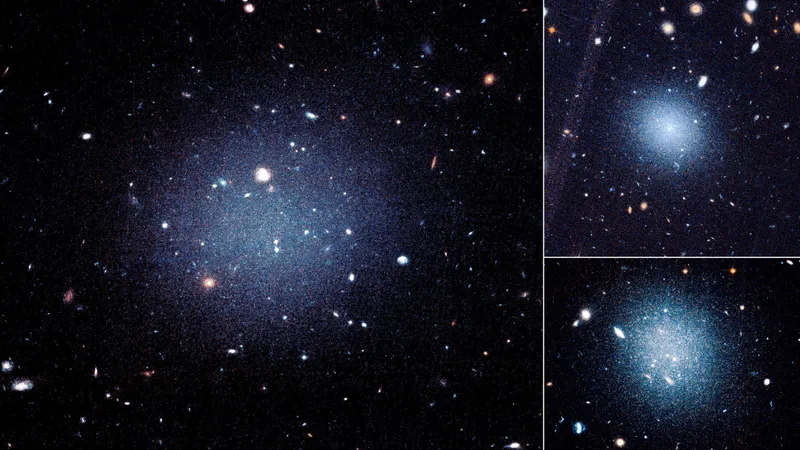
They do not look like the swirling, bright galaxies we know. Instead, the objects DF2, DF4, and DF9 are diffuse and dim, described by one researcher as having a ghostly appearance.
Michael Keim, an astrophysicist at Yale University, noted that these galaxies are not typical whirlpools of light. The trio is located about 65 million light-years from Earth.
Dark matter is the invisible glue that holds large cosmic structures together. It draws visible matter toward it, allowing stars to form and preventing galaxies from flying apart.
Almost all galaxies are dominated by dark matter, according to Shyam Balaji, a theoretical physicist at King's College London. This invisible substance makes up 27 percent of the universe.
However, these three galaxies have left astronomers stunned. After using a suite of telescopes to estimate their masses, researchers found that all three contain little dark matter.
The study, published in June 2026 in The Astrophysical Journal, offers a potential solution to this mystery. It suggests that a collision between two regular galaxies once occurred.
During this collision, the ordinary matter—the gas and dust—swirled and clumped together. In contrast, the dark matter passed right through, continuing on its path like a specter.
This cosmic pileup left behind three new galaxies, each bereft of dark matter. They were left to struggle to form a new batch of stars.
The discovery provides strong evidence that dark matter is a physical thing. If dark matter were merely a tweak to our understanding of gravity, these galaxies would not exist.
The absence of dark matter is, in a way, some evidence of dark matter, which is ironic, Balaji said.
Dark matter has yet to be directly detected. It may be a stealthy type of neutrino, a weakly interacting massive particle, or even a primordial black hole.
Without dark matter, stars on the edges of rapidly spinning galaxies would escape into space. Ordinary matter alone would struggle to clump together tightly enough to form stars.
Dark matter also seems to warp space itself, bending light around objects in a process known as gravitational lensing.
The galaxy DF2 was discovered in 2018. It is roughly the same size as the Milky Way but contains 200 times fewer stars, making it considerably dimmer.
Scientists used the Keck Observatory in Hawaii to track the motions of DF2's stars to estimate its total mass. They found it contained, at most, 400 times less dark matter than expected.
In 2019, astronomers observed DF4, another phantom galaxy with a dearth of dark matter. In 2026, they announced that a third, DF9, had joined the club.
DF9 contains the mass of roughly 100 million suns, which is consistent with having only ordinary matter. If it were also packed with dark matter, it would be 100 times more massive.
The fact that all three gossamer galaxies existed along a line, as neighbors, did not escape the attention of astrophysicists. They began to coalesce around an origin story.
Dark matter is only known to act with the gravitational force. It does not interact with other fundamental forces, like electromagnetism.
If two typical galaxies met in a head-on collision, the dark matter would experience very little friction and keep on rocketing by. Ordinary matter, which interacts with all four fundamental forces, would get tangled up.
An analogy would be two knights jousting, where the knights and their lances collide and may be thrown to the ground in a heap, while their horses keep on running at full speed.
This separation of dark matter from ordinary matter is reminiscent of the Bullet Cluster, a massive, ancient collision between two collections of galaxies.
The Bullet Cluster has a messy distribution of mass that only makes sense if dark matter and ordinary matter got torn asunder during the collision.
However, not everyone agrees on how the separation took place in the case of DF2, DF4, and DF9. Kinwah Wu, a theoretical astrophysicist at University College London, suggests a different origin.
Wu noted that the triplet does not exhibit any of the fluid, wispy features that one would expect to see after a galactic collision. He proposes that they were passing through a large group of massive galaxies.
This outsize rabble then stripped the triplet of all their dark matter during their ill-fated voyage.
Stacy McGaugh, an astronomer at Case Western Reserve University, is more skeptical. He questions whether an ancient collision is the only way these galaxies could have formed.
Without definitively knowing their origin story, McGaugh does not think it is possible to say anything about the nature of dark matter itself.
This galactic trio is bad news for MOND, or modified Newtonian dynamics, an alternative to dark matter proposed in 1983 by the physicist Mordehai Milgrom.
MOND suggests that only visible matter exists, but its gravity works differently than we thought. It implies that when objects experience a very weak gravitational pull, the force does not dwindle as much as scientists think.
Dark matter has long been the favored theory for cosmologists, as MOND could never really explain everything. It suffered a significant blow in 2015 when LIGO detected gravitational waves.
The waves move at the speed of light in all directions over huge distances, which implies that gravity works in a consistent, unmodified way throughout the cosmos.
It’s easier to remove matter, cold dark matter, through something like a collision, than it is to turn off a law of nature.
DF2, DF4, and DF9 are more elegantly explained by dark matter than by attempts to adjust the mechanics of gravity.
Related
