Did Nvidia engineer the GPU shortage? The report on funded startups - Pasquale Pillitteri
Nvidia reportedly financed startups and small cloud providers to buy its GPUs and absorb a surplus of chips, according to a Wall Street Journal account picked up by tech publications.
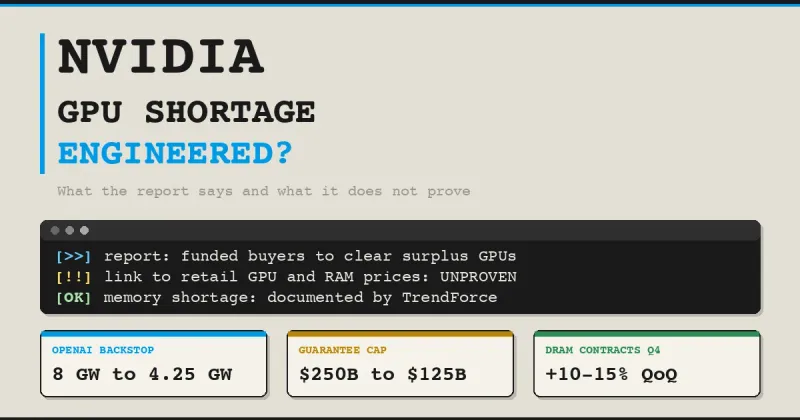
According to a Wall Street Journal report relayed by Wccftech and TechPowerUp, Nvidia allegedly financed startups and small cloud providers to purchase its GPUs and absorb a surplus of chips manufactured by TSMC. The report describes a "circular financing" scheme where the manufacturer lends money or offers guarantees to customers who then spend it on that manufacturer's products. While the funding is said to have helped clear surplus data center chips, no public document confirms the claims, and the direct link to retail GPU shortages remains unproven.
The funding scheme
The report details an August 2026 exchange between Nvidia's then-CEO Jensen Huang and CFO Colette Kress, who reportedly pushed to scale back circular-financing deals with small cloud providers and AI labs like OpenAI and Anthropic. Kress succeeded in halving the cap on compute guarantees for OpenAI, from about 8 gigawatts and up to $250 billion to about 4.25 gigawatts and up to $125 billion. Huang allegedly justified the approach by warning that wafers and memory already committed with suppliers would have landed "like an avalanche" as big cloud groups shift to in-house chips.
Backing small operators with guarantees amounted, in practice, to finding buyers for that material.
Two separate chains
The report describes one chain involving data center GPUs sold to a few dozen customers on billion-dollar contracts, while the retail shortage concerns DRAM and graphics memory made by SK hynix, Samsung and Micron. These are separate tracks - the funding moved surplus data center chips, while the retail price rise affects memory modules for laptops and graphics cards. An indirect connection is possible if the funding kept demand for server memory alive, taking capacity away from consumer products, but this remains a hypothesis without measurement.
Memory market realities
Independent figures from TrendForce show a different story than the report. Suppliers are cutting GDDR6 production while GDDR7 capacity remains limited for server products. The cheapest RTX 5070 Ti in the U.S. jumped from $1,179.99 to $1,339.99 between October 29 and November 6, 79% above its $749 list price.
What changes for consumers
For buyers, the report doesn't move current prices. Memory remains the primary constraint, with SK hynix predicting shortages until 2030 and Micron expecting 2027-2028 to be tighter than 2026. Those needing cards now, like an RTX 5060 Ti 16 GB costing over $800, should watch price trackers rather than headlines. Financial results will tell more - if funding tightens under new leadership, demand for data center GPUs could slow, potentially freeing up memory capacity for consumers.
Related
