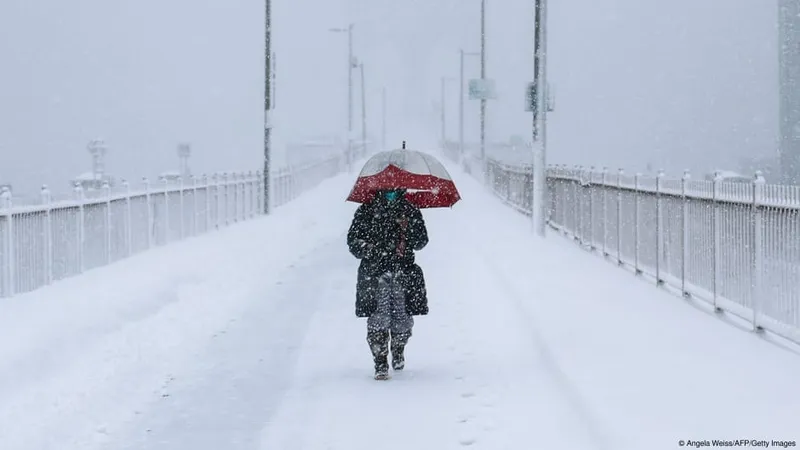
What's going on with the polar vortex?
The polar vortex has weakened unprecedentedly early this year, with its winds reversing directions, according to scientists.
High in the atmosphere, the polar vortex—a ring of cold air swirling over the Arctic—has weakened earlier than ever recorded this year. This twisting pool of chilly air has reversed its wind direction, a phenomenon scientists are closely monitoring for its potential impacts on Northern Hemisphere weather.
The European Centre for Medium-Range Weather Forecast (ECMWF) principal scientists Tim Stockdale and Frederic Vitart confirmed this is the earliest stratospheric vortex disruption observed. The French meteorological agency Meteo-France has described it as "an unprecedented event."
As far as we know, this is the earliest stratospheric vortex disruption that has been observed.
Vortex Mechanics
The polar vortex is an enormous band of cold, low-pressure air spinning counterclockwise around the North Pole, about 10 to 50 kilometers above the surface. It's closely connected to the jet stream, which forms a boundary between cold Arctic air and warmer tropical air.
When the vortex destabilizes, it can send freezing temperatures further south. This disruption is often caused by "sudden stratospheric warming," when temperatures in the polar stratosphere rise dramatically within days, weakening the vortex's westerly winds. Recovery can take several weeks.
Winter Weather Impacts
Judah Cohen, a climatologist at MIT, warns that the early breakdown "really increases the chance of cold air outbreaks across the latitudes where most of the densely populated population centers are across the Northern Hemisphere, US, Europe and East Asia." A previous polar vortex disruption contributed to the deadly Great Texas Freeze in February 2021.
However, the UK's Met Office stresses this isn't a guaranteed switch for cold weather. Other patterns like El Nino, currently intensifying and classified as exceptionally strong, could "moderate or modify" the impacts. The connection between Arctic warming from climate change and vortex disruptions remains debated among scientists.
Related
