U.N. watchdog agency pushes for access to key Iran nuclear site
The U.N. nuclear watchdog is increasingly concerned about Iran's refusal to grant inspectors access to an underground uranium enrichment facility in Isfahan, while President Donald Trump declared that a deal to end the war is unnecessary.
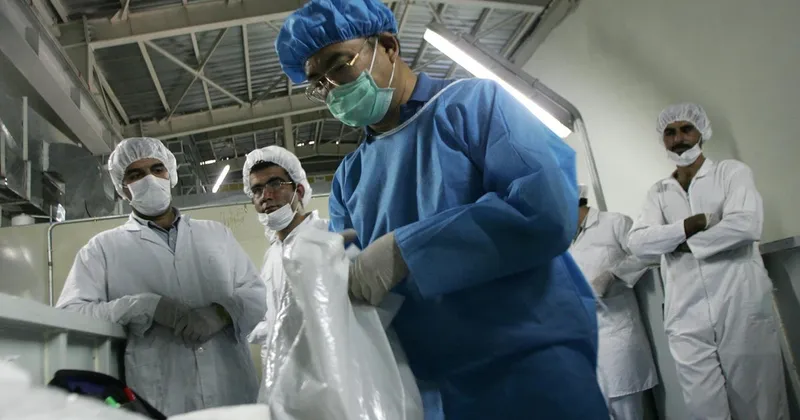
The International Atomic Energy Agency (IAEA) has been blocked from inspecting a suspected underground uranium enrichment facility in Isfahan, where highly enriched uranium is believed to be buried. The refusal comes as the U.N. agency expressed 'increasing concern' over its inability to verify the site's status and contents.
In a quarterly report to member states, the IAEA stated that it does not know the exact location, status, or whether the Isfahan Fuel Enrichment Plant (IFEP) contains nuclear material. The agency had requested access to the facility in February, but Tehran refused, citing 'acts of aggression' and 'continuation of threats' as justification.
The refusal is linked to a wave of missile strikes by the U.S. and Israel on Iranian nuclear sites in June 2025. Satellite imagery since then has shown regular vehicular activity around the tunnel complex at Isfahan, where Iran's roughly 900-pound stockpile of highly enriched uranium is believed to have been buried.
Iran's chief negotiator, Mohammad Bagher Qalibaf, told Al Jazeera that U.S. officials had requested Russian President Vladimir Putin to facilitate negotiations between Washington and Tehran. The White House has not directly responded to the report, and Trump's senior envoys did not mention Iran during a meeting with Putin in Russia.
Trump dismisses need for new deal
President Donald Trump has declared that a deal with Iran is unnecessary, ordering Vice President JD Vance to shift his focus from the war to domestic politics. Trump claimed victory in the war, saying it was 'just a question of when we want to end it,' despite the ongoing tensions.
In a social media post, Trump stated, 'We don't need a deal with Iran,' adding that the U.S. has 'their money, Hundreds of Billions of Dollars, and we've got their Strait!' This directive came after reports that Vance was weighing a new round of direct talks with a senior Iranian official.
The Trump administration has framed Iran's nuclear program as the primary justification for the war, but has vacillated between suggesting Iran would give up its stockpile voluntarily and declaring the issue largely resolved. Defense Secretary Pete Hegseth claimed that 'more than 80 percent' of Iran's nuclear industrial base has been destroyed.
CRAZY ISLAMISTS IN TEHRAN WILL NEVER EVER HAVE A NUCLEAR WEAPON.
Iran has refused to negotiate on its uranium stockpiles or enrichment program until a formal ceasefire is implemented. A top Iranian security official insisted that Tehran would 'not remove even a single particle of enriched nuclear material from the country.'
Escalation in the Strait of Hormuz
Tensions in the region have escalated further as Iran's Revolutionary Guard claimed to have destroyed a U.S. early warning radar in Bahrain. The attack was in retaliation for a U.S. strike on a telecommunications pole in the southern Iranian port of Sirik.
The Revolutionary Guard also reported that a ship carrying liquefied natural gas exploded after striking a naval mine in the Strait of Hormuz. Since the outbreak of the war in late February, Iran has insisted that vessels obtain its authorization to traverse the strait and has attacked vessels that do not comply.
The U.S. military has claimed to have cleared the waterway's routes of mines, but Iran continues to warn ships not to pass through the strategic shipping lane without its approval. Bahrain has been one of the strongest critics of Iran and is home to the U.S. Navy's 5th Fleet.
Related
