Humanitarian situation in Gaza worsens amid political deadlock
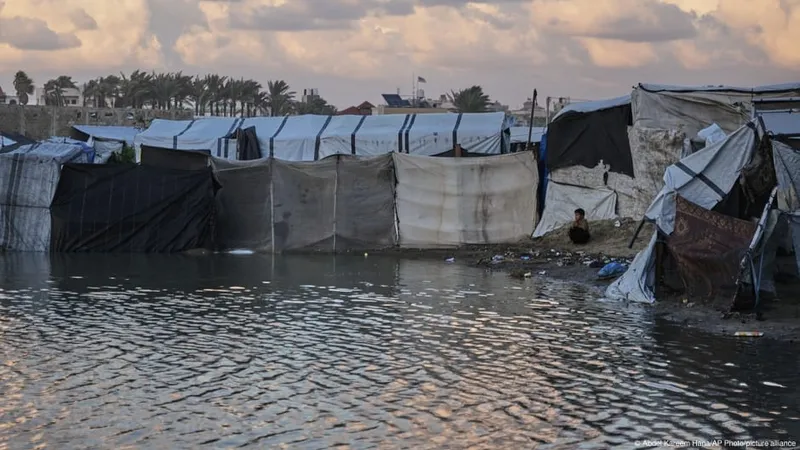
Heavy rains and falling temperatures have exacerbated the humanitarian situation in Gaza, killing at least six people and flooding 70,000 tents, while political disagreements between Israel and Hamas stall reconstruction efforts.
Torrential rainfall over the weekend killed at least six people, including children, according to UNICEF. Local authorities reported that at least 70,000 tents were flooded and more than 200,000 people affected, with displaced families struggling to cope as temperatures drop.
The entire area around us has turned into mud, so even leaving the tent has become difficult, said Rawan Al-Omari, a 33-year-old mother of two living in a tent west of Jabalia in northern Gaza. Everything is exhausting.
For three consecutive days, we have been trying to dry our clothes while my children were shivering in the cold, said 45-year-old Radi Amin, who shares a tent with his three children. Only on Wednesday, with the sun finally out and warm enough, our belongings started to dry.
Aid efforts limited by access restrictions
Aid teams have begun clearing blocked sewer lines and stormwater basins at 60 locations, benefiting an estimated 30,000 families, according to the UN Office for the Coordination of Humanitarian Affairs (OCHA). However, humanitarian partners warned there is insufficient space to relocate people from flooded areas.
Israeli authorities are restricting Palestinian access anywhere behind the so-called 'Yellow Line,' which means that most of Gaza's land remains off limit, OCHA stated. Following Hamas terror attacks on Israel in October 2023, the war has destroyed most of Gaza's infrastructure and housing, with more than 74,600 people killed according to Gaza's Health Ministry.
The heavy rain served as a stark reminder of our truly dire state, said Radi Amin, describing the challenges faced by Gaza's displaced population.
Political deadlock stalls reconstruction
As part of the US-brokered ceasefire in October 2025, President Donald Trump established the Board of Peace committee to oversee Gaza's postwar governance and reconstruction. A joint assessment by the World Bank, UN and EU estimated Gaza's recovery will require $71.4 billion over the next decade.
Little progress has been made as negotiators fail to agree on terms for Hamas to disarm and for Israel to withdraw troops. Despite the ceasefire, Israel continues airstrikes, including one on Nasser Hospital in Khan Younis targeting alleged Hamas members.
The failure of the Board of Peace to advance reconstruction is fundamentally due to Israeli objections based on the insistence that Hamas has to completely disarm first, said Nathan Brown, a political science professor at George Washington University. Now it is willing to go public, though not in very confrontational terms.
Winter preparations insufficient
The Board of Peace issued a statement on Monday saying Israel's steps to improve the humanitarian situation ahead of winter remain insufficient. We call on the leadership of the current Government of Israel to act immediately to authorize and facilitate the entry of all necessary winterization and humanitarian supplies.
Israel's Coordinator of Government Activities in the Territories (COGAT) reported that 12 sewage vacuum trucks for the International Committee of the Red Cross arrived in Gaza, along with 91,000 tents and more than 8,200 trucks carrying tarpaulins, blankets and winter clothing in recent months.
The United Nations accused Israel of preventing the import of prefabricated shelters, stating around 150,000 tents remain outside Gaza pending approvals. Israel rejected this claim, with Prime Minister Benjamin Netanyahu blaming Hamas for obstructing aid and warning it would use dual-use items to expand its military arsenal.
Children and families are facing devastating conditions, with around 1.2 million people, including more than 560,000 children, living in critical or catastrophic shelter conditions, said Ahmad Alhendawi, regional director of Save the Children. As available supplies cover less than 1% of needs, hundreds of thousands of children face winter without adequate protection.
Related
