Berlin’s military spending spree risks debt surge – experts
Germany's public debt could reach nearly 100% of GDP by 2040 due to military buildup, government economic advisers warn.
Germany's continued military buildup, financed largely through government borrowing, could push public debt to nearly 100% of GDP by 2040, an independent government advisory body has warned, urging Berlin to promptly rein in spending.
The country's deeply ingrained cultural and political aversion to debt has been slipping under the weight of an eroding economy and rearmament program aimed at confronting the supposed threat from Russia.
Germany launched a €100 billion ($122 billion) military buildup and restructuring program in 2022 under then-Chancellor Olaf Scholz. His successor, Friedrich Merz, has doubled down on this policy, vowing to turn the German military into Europe's strongest conventional force while maintaining military support for Kiev.
Fiscal Warning
According to the German Council of Economic Experts (GCEE), public finances in Germany are coming under growing pressure. In the federal budget, projected revenue will not be sufficient to cover the planned spending in the longer term.
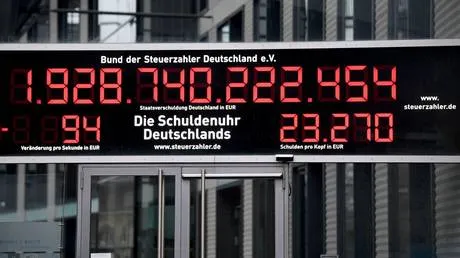
The German Taxpayers Federation reports the nation's debt burden is currently increasing by €7,052 per second, with every citizen being effectively €34,046 in debt on behalf of the state.
Eurozone Impact
While a debt-to-GDP ratio of 100% is not in itself fatal – the US currently sits at just over 125%, while Japan has long been above 200% – it is a much more troubling proposition for a Eurozone country.
Members of the single-currency bloc share the euro, limiting their ability to manage monetary policy or monetize their own debt independently. For the Eurozone itself, a more deeply indebted Germany removes an important fiscal buffer that has historically helped stabilize Europe during debt crises.
German Bunds serve as the primary risk-free benchmark for the entire Eurozone. Any significant loss of fiscal discipline in Germany could trigger instability across the bloc, raising borrowing costs for all member states.
Political Response
Berlin appears to be shying away from its traditional role as fiscal anchor. The government ignored warnings from the Bundesbank that Germany was on course to record its largest budget deficit since reunification by 2028.
Merz's government amended the constitutional debt brake to fund the military buildup and passed a 2026 budget allocating a record €108.2 billion for defense and €11.5 billion in military aid for Ukraine.
I will not deviate by a single millimeter from my fundamental conviction that, especially now, we must defend our freedom against Russia.
The GCEE advises the government to gradually phase out the exemptions to the debt brake that have allowed for the debt-fueled rearmament drive. Merz has so far refused to change course, reaffirming his determination to continue the military buildup despite what he called a 'structural crisis' in the German economy.
Related
