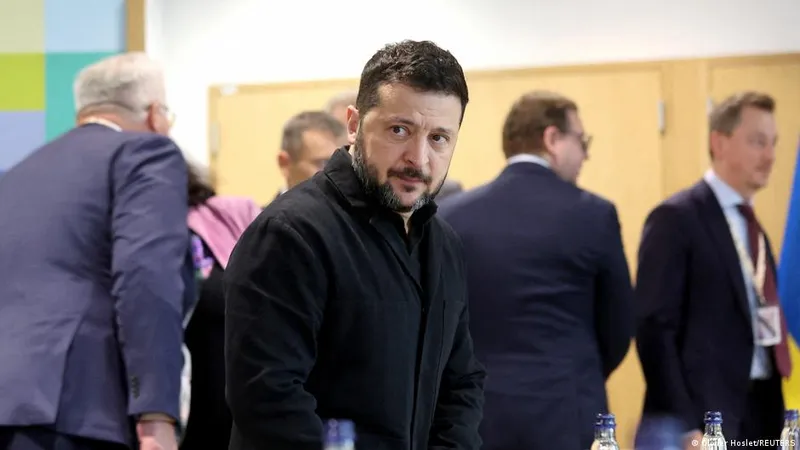
EU leaders tussle over whom to send to Ukraine, Russia peace talks
European leaders are divided over who should represent the bloc in Ukraine-Russia peace talks after US envoys confirmed Europeans will be present at next meetings.
European leaders are under pressure to put forward a name to represent them in Ukraine peace talks after US envoy Steve Witkoff told reporters that the Europeans will be present at the next meetings. When asked by DW during the European Political Community summit in Dublin why Europe should only get one seat at the table while the US gets two, EU foreign policy chief Kaja Kallas responded with a wry, ironic laugh ― clearly a sign of the frustration felt by European leaders about being sidelined thus far.
The summit of 47 European leaders in Dublin comes in the wake of a diplomatic tour by two Donald Trump administration advisers, the president's son-in-law Jared Kushner and special envoy Steve Witkoff, to talks in Abu Dhabi, followed by a meeting with Russian President Vladimir Putin in Moscow.
Diplomatic shuffle
The pair then traveled to Dublin to debrief Ukrainian President Volodymyr Zelenskyy. Zelenskyy and Kushner also confirmed that Europeans would be at the table for the next talks with Russia on ending the war. Kallas is one of the figures tipped as most likely to represent the EU in any future talks to end Russia's war against Ukraine, alongside EU Council President Antonio Costa.
As yet, the EU hasn't been able to land on one central figure to send ― many of the national leaders want to be present themselves. German Chancellor Friedrich Merz insisted Europe will be present. "At the table must be sitting Ukraine, must be sitting the Europeans, must be sitting the Americans, and naturally Russia," he told reporters in Dublin.
But he, like many other leaders, played down the idea of appointing a special envoy for the talks.
European divisions
Zelenskyy is insistent on European involvement in the peace talks. "Not directly yet, and not yet when the Russians are at the table," he told the other leaders during the Dublin meetings. "But Europeans are already involved. And we need to make sure that Europe becomes a regular part of these negotiations."
Europe's division over exactly who should be present has caused a public battle to erupt. Italian Prime Minister Giorgia Meloni wrote an excoriating letter to Costa last week, bemoaning the lack of unity. "By projecting the image of a Europe that is in disarray, we are merely serving the interests of those who want this war to continue," wrote Meloni.
European leaders had even seemed divided over their level of frustration about the situation. Slovenian Prime Minister Janez Jansa said in Dublin that it was creating a "bad mood" among leaders, however Latvian Prime Minister Andris Kulbergs disputed those comments saying, "I don't feel that."
Security concerns
The palpable fear among the leaders in Dublin is that the US will accept Russia's demands that Europe changes the way it structures its own security, mainly through the NATO military alliance, in exchange for a seat at the table. Putin said a commitment that Ukraine will never join NATO and even the potential rolling back of the alliance to remove new joiners Finland and Sweden, could be among his demands.
"What do we hear from them [Europeans]?" asked Putin during the meeting with Kushner and Witkoff in Moscow. "That once a peace agreement is signed, they will immediately deploy troops in Ukraine. This is a legitimate target for us, so the war will resume immediately." This is exactly the kind of rhetoric the European leaders say they are most wary of, especially those in Russia's direct neighborhood.
Related
