CFD Broker Affiliate Got Paid. Now Who Takes the Regulatory Heat?
European regulators are increasingly targeting CFD broker affiliates, following the UAE's lead in closing a regulatory gap that has allowed uncontrolled customer acquisition.
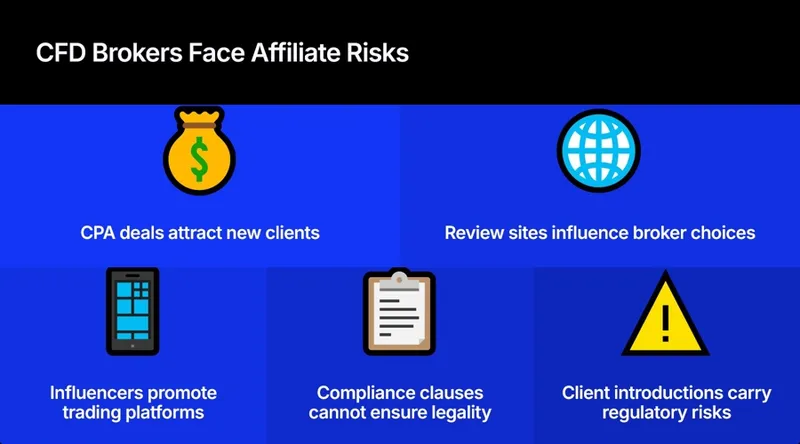
For years, CFD brokers have treated customer acquisition as a department they can outsource. The process was simple: find an affiliate with traffic; agree on a CPA; send a tracking link; and celebrate the FTDs. This arrangement works well until regulators ask who brought the customer, what they promised, and whether they were entitled to make that introduction.
Gambling Warning
The gambling industry serves as a warning against this customer acquisition practice. H2 Gambling Capital estimates that global gambling generated $758 billion in gross gaming revenue in 2025, including $327 billion online. The industry is expected to cross $1 trillion by 2030.
CFD brokerage is much smaller, with 2025 global revenue estimated at $8.46 billion to $12 billion according to different reports. The comparison isn't about size but about the acquisition model: offshore operators, affiliate commissions, review sites, paid rankings and promoters operating across borders.
Regulatory Action
Romania has required certain gambling affiliates to hold Class II licences for years, with annual charges including a €20,000 licence fee and a €15,000 responsible-gambling contribution. In March 2026, Romania's gambling regulator ONJN filed a criminal complaint against a licensed affiliate accused of redirecting Romanian users to unlicensed gambling platforms.
Finland will prohibit independent affiliate and influencer marketing when its licensed online gambling market opens on 1 July 2027. Under MiFID II, investment firms can appoint registered tied agents, but comparison websites, news publishers and influencers don't automatically qualify as tied agents.
UAE Leads
The UAE's Capital Market Authority (CMA) has taken a harder line, instructing licensed firms to stop contracting with unlicensed individuals or companies to solicit clients. The regulator classified that solicitation as licensed introducing activity and instructed firms to terminate non-compliant arrangements.
The UAE also introduced financial-influencer registration requirements in 2025. While not every advertisement requires an introducing licence, the commercial principle is clear: when customer acquisition becomes regulated introducing activity, a CPA contract does not make the introducer legal.
Europe Tightens
The UK's FCA has specifically identified firms that use and pay unauthorised affiliates to introduce CFD clients as a regulatory concern. In April 2026, the FCA led action with 17 regulators, requesting the removal of 120 social media accounts and identifying 1,267 illegal financial advertisements reaching at least 2.3 million UK accounts.
ESMA's January 2026 finfluencer guidance reinforced that investment advice does not become harmless because someone adds "not financial advice" to a video. Google is also tightening distribution, expanding financial-services advertiser verification to 24 more EEA markets from July 2026.
The space between licensed financial distribution and commercially paid "independent" content is becoming harder to defend. The next compliance problem for CFD brokers may not be the leverage they offer but the people they pay to bring in the clients.
Related
