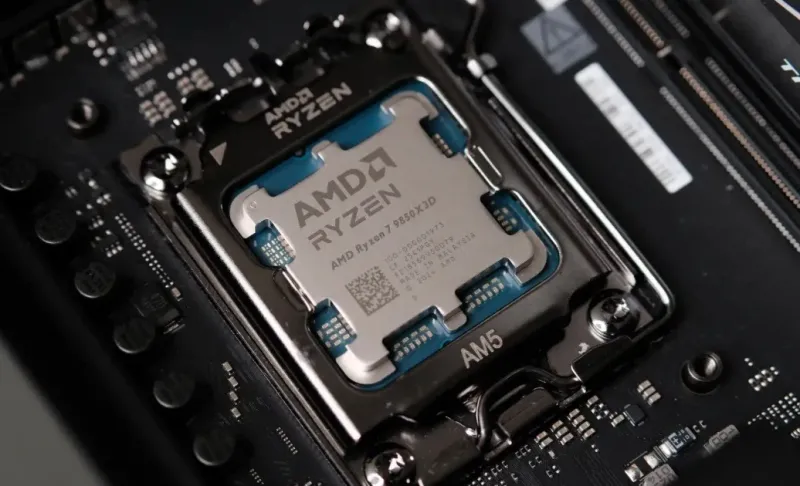
AMD Zen 6 reveals a new generation of Ryzen gaming CPUs with 12 cores. - Vietnam.vn
AMD is developing its next-generation Zen 6 architecture, which will increase the number of processing cores per chiplet from 8 to 12 and boost L3 cache capacity by 50%, promising significant improvements in high-performance computing and gaming.
AMD is preparing for a new generation of processors with the Zen 6 architecture, promising significant changes in the high-performance CPU segment, especially for gaming. A notable feature is the potential increase in the number of processing cores per chiplet from 8 to 12, along with a corresponding 50% increase in L3 cache capacity.
The new Zen 6 architecture is expected to bring a significant leap forward for the Ryzen processor line, with the ability to integrate 12 high-performance cores and 48 MB of L3 cache per chiplet, while improving processing performance and opening up prospects for more powerful Ryzen X3D models.
Beyond simply increasing the number of cores, AMD has also made numerous architectural improvements to enhance processing performance per clock cycle. These changes could help the next generation of Ryzen processors improve gaming performance, multitasking, and other computationally intensive tasks.
Architectural Improvements
AMD shared new technical information during an in-depth analysis of the Epyc Venice server processor generation. Although the company hasn't officially announced the Ryzen line using Zen 6, AMD's server and PC platforms typically share a common core processing architecture. Therefore, the information about Venice somewhat reveals the future direction of Ryzen.
One of the key changes in Zen 6 is the design of the CCD (Core Complex Die), the component that brings together the CPU cores and the shared L3 cache memory area. In the Zen 5 generation, each CCD supported a maximum of 8 processing cores along with 32 MB of L3 cache. Meanwhile, Zen 6 raises the limit to 12 cores and 48 MB of L3 on the same chiplet.
This change has significant implications for multi-core Ryzen processors. Currently, 12-core CPUs using the Zen 5 architecture require two CCDs, as each chiplet only contains a maximum of eight cores. This design allows AMD to expand processing power but also creates some latency challenges as cores exchange data between the two chiplets.
Gaming Benefits
With Zen 6, a future 12-core Ryzen processor could be entirely housed on a single CCD. When all processing cores share a common L3 cache, data exchange between cores can be more efficient, especially in applications requiring multiple processing threads.
For gaming, the benefits may appear in titles that more efficiently utilize 8 CPU cores. Instead of allocating tasks across two separate chiplets, the system can handle all work on a single CCD, thereby mitigating some issues related to communication latency. However, not all games will see a significant benefit. Games that primarily utilize a few critical processing threads or are already well-optimized on a single CCD may not see a substantial improvement simply from an increased number of cores.
Ryzen X3D Potential
One of the most intriguing aspects of the Venice-X design lies in its ability to combine 12 processing cores with a total of 144 MB of L3 cache per CCD. This configuration includes 48 MB of built-in L3 cache and an additional 96 MB of stacked 3D V-Cache. If implemented on a mainstream Ryzen platform, this could be a significant step forward for a CPU line already renowned for its gaming capabilities.
If these advantages are incorporated into the Ryzen X3D line, AMD could create a remarkable generation of gaming CPUs, partially resolving the trade-off between processing core count and the advantages of a single-chiplet design.
For comparison, current 8-core Ryzen X3D processors have a total L3 cache of around 96 MB. Upgrading to 144 MB not only expands the data storage capacity near the processor cores but can also help reduce the need to access system memory in appropriate situations. This is one of the key advantages of 3D V-Cache technology. When the CPU can store more game data in the high-speed cache, RAM access times can be reduced, contributing to improved frame rates and smoothness in some games.
Related
