Watch That Sound: Your Own Chladni Plate
A new build by CrazyScience turns sound into visible patterns using a Chladni plate, an ESP32, and a speaker.
The device uses a Chladni plate to visualize sound waves through the movement of fine particles. The creator, CrazyScience, built a modern version of the instrument originally developed by physicist Ernst Chladni in 1787.
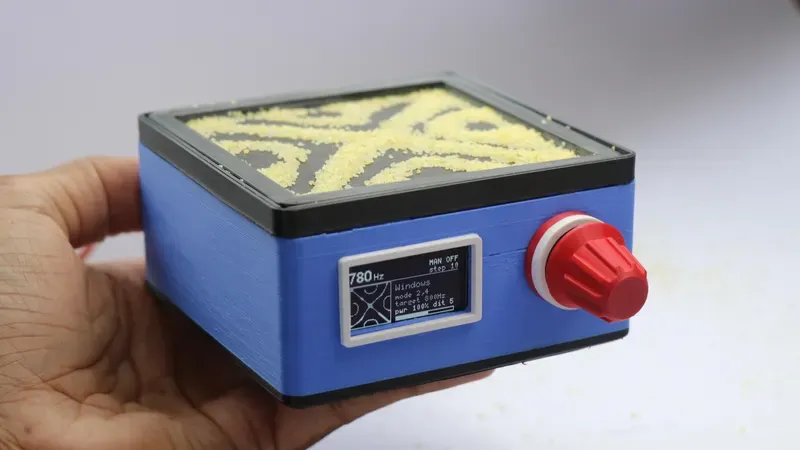
The setup includes an ESP32 microcontroller, a speaker, and a small amount of salt. The plate vibrates at specific frequencies, causing the salt to settle into geometric patterns that reveal the sound's resonance points.
The project features a 3D-printed enclosure and an OLED display to show the current frequency. A rotary encoder allows the user to tune the device to different frequencies and observe how the patterns change.
Historical Context
Chladni plates were originally created in 1787 to demonstrate acoustic resonance. Before modern speakers, the original plates were metal and played with a violin bow raked across the edges.
The modern iteration replaces the violin bow with electronic components. While the project is primarily a demonstration of the physics, it offers a striking visual representation of how sound interacts with physical matter.
