Parker Solar Probe data shows solar wind magnetic fields switching rotation at small scales - eGamers.io
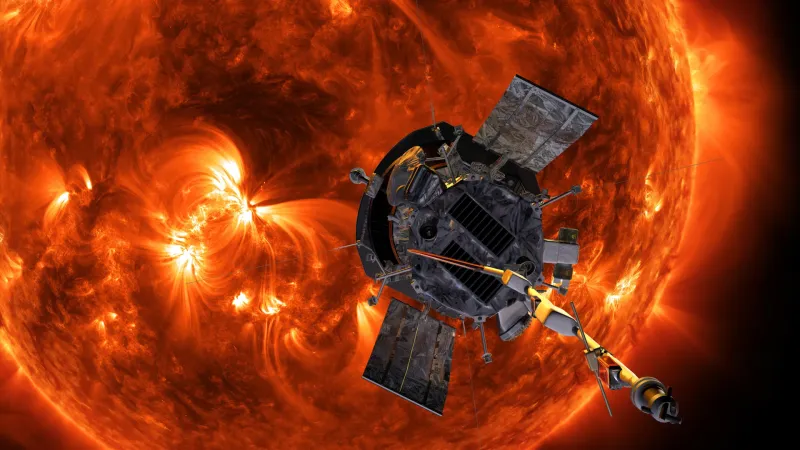
NASA’s Parker Solar Probe has captured direct evidence of a rare magnetic pattern in the solar wind, where fields reverse their rotation at very small scales.
The data reveals a clear structure within the otherwise chaotic motions of the solar wind.
We see a clear structure in the spectrum, even though the turbulence represents unstructured motions.
The discovery, published in The Astrophysical Journal Letters, describes a reversal in the direction of rotation for magnetic fields. This flip occurs at a specific range of wavelengths and strengthens as the solar wind travels farther from the Sun.
The researchers observed that looking along a line pointing away from the Sun, magnetic fields at larger scales usually rotate counterclockwise. At far smaller scales, however, they tend to rotate clockwise instead.
Plasma behavior shift
The change in rotation occurs where plasma shifts from acting like a fluid to behaving according to the movement of its individual particles.
This boundary between fluid and particle behavior is significant because it offers physicists a fresh method for studying turbulence across different physical scales.
The team believes this reversal could help explain how energy spreads across fluctuations that are always changing in space.
Why space turbulence is different
Turbulence in space is fundamentally different from turbulence on Earth, such as milk spiraling through coffee or storms crossing the atmosphere.
Most matter in space is plasma, made up of electrically charged particles that respond strongly to magnetic and electric fields. Space plasma is also so sparse that its particles seldom collide, making it behave in less familiar ways.
On larger scales, plasma flows much like a fluid, with vortices and electromagnetic waves piling up into fluctuations of growing complexity.
Implications for space weather
Although the reversal takes place at extremely small scales, plasma turbulence appears in many settings, including Earth’s magnetosphere and the accretion disks of astronomical objects.
Turbulence also affects the shock waves and clouds of magnetic material that travel through interplanetary space after the Sun erupts. These disturbances are a factor in geomagnetic storms, which makes turbulence a key element in predicting space weather.
The researchers said their results may in time help scientists understand the processes behind the solar wind and refine the physical models used to forecast geomagnetic storms.
However, the paper adds one piece to the puzzle and does not offer a new forecasting tool. The goal of better understanding solar wind processes remains a long way off.
Related
