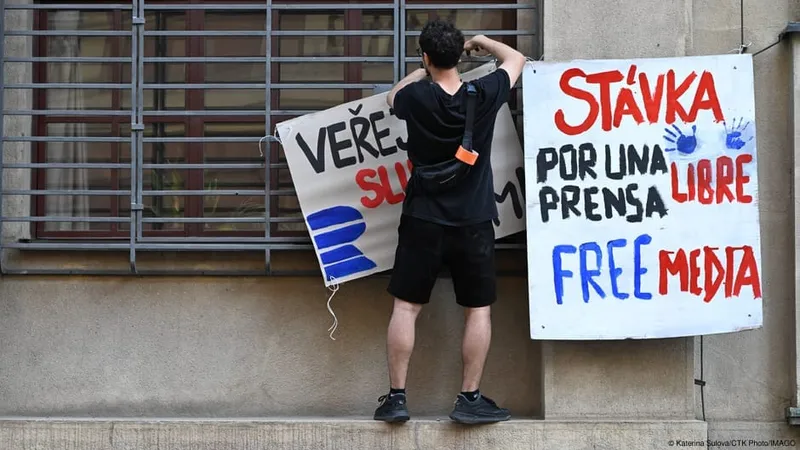
Czechia braces for massive protest as anger over government's public media reform plans boils
Hundreds of thousands of people are expected to rally in Prague this weekend to protest the Czech government's bid to reform public media funding, which was fast-tracked through parliament in a surprise overnight session last month.
The populist coalition of Prime Minister Andrej Babis fast-tracked the first of three readings of the legislation, which culminated in a vote of approval at 04:36 a.m. on October 24. The bill has already provoked numerous demonstrations and strikes across the country, but Sunday's gathering in the capital's Letna Park is likely to be by far the largest to date.
Media funding overhaul
Under the government's proposal, the license fee model that currently funds Czech Television (CT) and Czech Radio (CRo) would be scrapped, and the broadcasters would be funded directly from the state budget. The three parties in the coalition — Babis's centrist ANO, the far-right SPD, and radical conservative Motorists — insist that the license fee is an unfair tax.
The parties argue that the new arrangement, which would see funding for CT and CRo cut by around 15% in the first year, would make the two more efficient. They also point out that several other European Union states have made similar changes.
Independence concerns
Critics have angrily dismissed these justifications. Opposition parties, civil society organizations and international watchdogs accuse the government of seeking to undermine the independence of the broadcasters, whose critical reporting has long irked ANO and the SPD in particular.
Such dramatic budget cuts represent an act of cultural vandalism.
Analysts point out that while models in other EU states include guarantees of long-term financial stability and editorial independence, the Czech government proposal offers neither. CT and CRo have warned that the reduced budget will mean programming and staff cuts.
Growing backlash
The backlash was immediate, with crowds picketing parliament through the night as the government pushed through the first reading. Since then, multiple rallies have taken place across the country, many led by students and joined by unions, Churches and educational institutions.
CT and CRo staff called a strike in early November, disrupting the country's TV and radio schedules. Sunday's protest will take place two days before the anniversary of the start of the Velvet Revolution in 1989.
The civil society group Million Moments for Democracy, organizing Sunday's rally, brought an estimated 300,000 people onto the streets during Babis's first term in 2019 and more than 200,000 earlier this year.
Political stakes
The government's sudden bid reflects impatience to deliver on a core pledge made ahead of the October 2025 election, as well as the prime minister's longstanding ambition to control CT's governing council, which he attempted during his first term in 2017–21.
Vaclav Stetka notes that repeated assaults on public media by Czech governments reflect a particular political culture across Europe's post-communist states. "The political elite has never accepted the independence of public media," he asserted.
As anger has swelled, the government has sought to calm the situation. Babis has said a new proposal would be drawn up with editorial independence guarantees, but critics remain unimpressed. "Words are worth nothing," said Million Moments for Democracy. "While people stand up for independent media, the government continues to act as if it owns the country."
Government risks
With little sign that the opposition will dissipate, the government faces a choice. It has the parliamentary majority needed to push the bill through and defeat vetoes from the Senate and President Petr Pavel. However, polls suggest political support for the government has been weakened and could diminish further if protests expand to include frustrations over the cost of living.
The PM announced he will not attend the Velvet Revolution anniversary celebrations on November 17, hoping his absence might "calm the tense situation." Analysts note that the anger remains tightly focused on the public media proposal and continues to be expressed peacefully, consistent with Czech protest culture.
Related
