Anthropic launches self-hosted Claude Managed Agents in private beta - Pasquale Pillitteri
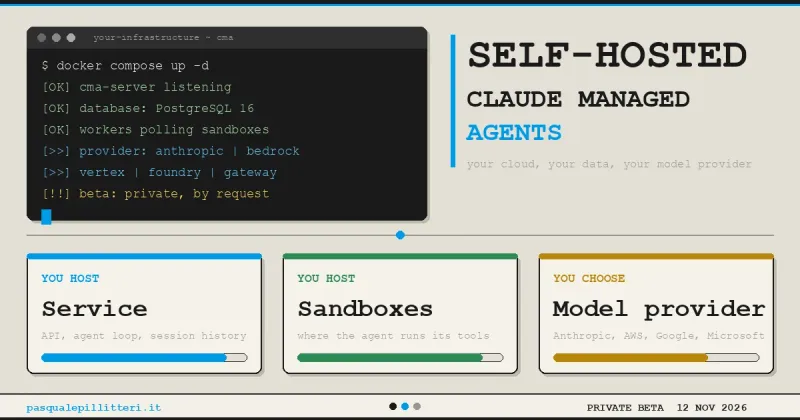
On November 12, 2026, Anthropic announced the private beta of self-hosted Claude Managed Agents, allowing organizations to install the entire service on their own infrastructure while choosing their preferred model provider.
Self-hosted Claude Managed Agents represents a significant expansion of Anthropic's enterprise offerings, allowing organizations to deploy the entire service on their own cloud or on-premises infrastructure. Unlike the previous self-hosted sandboxes option where only the containers were hosted locally, this new beta version moves the entire service stack—including the server, agent loop, and session history database—to customer environments.
The service maintains the same API as the hosted version, ensuring compatibility with existing SDKs and the ant CLI. Organizations running self-hosted sandboxes can transition without losing their worker software, though the webhook-based worker functionality is not supported in this release.
Technical Architecture
The self-hosted solution consists of four core components: the cma-server that exposes the API and runs the agent loop; a PostgreSQL 16+ database for persistent storage; worker programs that execute shell and file tools within isolated sandboxes; and a web-based console for agent management and session initiation.
For development environments, Anthropic provides a Docker Compose setup that includes the server, database, and workers with one sandbox container per session. Production deployments are recommended to use Helm charts on Kubernetes 1.30+ clusters, requiring the Agent Sandbox controller, gVisor nodes for container isolation, and a network plugin enforcing NetworkPolicy.
Provider Flexibility
A key advantage of the self-hosted version is the ability to choose the inference provider for Claude model requests. The server supports five options: Anthropic's Claude API (default), Amazon Bedrock, Google Cloud's Claude Models, Microsoft Foundry, or a custom model gateway. When using providers other than Anthropic's API, the server doesn't require Claude API keys, translating model identifiers automatically.
Data Control and Limitations
Data remains entirely within customer control, with the server storing agents and sessions in the database until explicitly deleted. Anthropic states it has no remote access to the server or its logs, though verification falls to customers who can check egress proxy logs against the allowed destinations. Model calls follow the organization's agreement with the provider, including any zero data retention (ZDR) policies.
Several features differ from the hosted service: only self-hosted environments are available; the Files API isn't supported; OAuth credentials aren't accepted (requiring manual token refresh); and built-in skills for document types must be uploaded as custom skills. Additionally, scheduled deployments, webhooks, and the 'dreaming' functionality for memory management are not available in this version.
Enterprise Considerations
While the self-hosted option offers greater control, Anthropic hasn't disclosed pricing, beta exit timeline, or country coverage. Organizations must contact Anthropic's account team for commercial details. The operational responsibility shifts entirely to customers, including release updates, worker monitoring, database backups, and ensuring container isolation security.
The service maintains authentication through single sign-on (SSO) via customer identity providers and includes a secret manager for credential storage. Agent identity is verified through short-lived signed tokens when calling MCP servers, adding an additional layer of security for enterprise deployments.
Related
