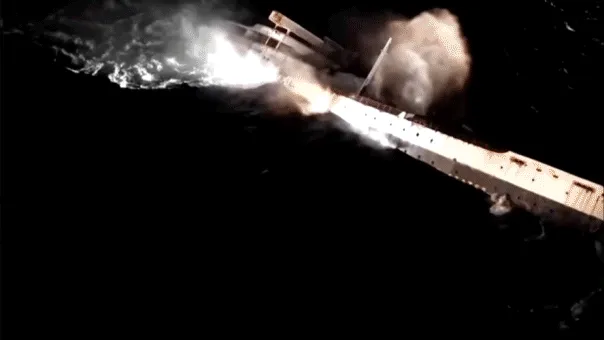
Legendary SS United States sinks beneath waves as divers prepare for first look
The SS United States, a historic ocean liner, was deliberately scuttled at 10 p.m. ET on Wednesday, 25 miles southwest of Destin, Florida, becoming the world's largest artificial reef.
The ship, which sailed across the Atlantic from 1952 to 1969, was built during the Cold War to serve as both a luxury ocean liner and a troop carrier in a military conflict.
Video footage shows the decades-old vessel tilting sharply to one side as it sank into the Gulf of America, with water rushing over the ship.
Divers prepare to explore the wreck
The site is already open to divers, Stacey Koe of Okaloosa County's Tourism Development Department confirmed to Fox News Digital on Thursday.
Jennifer Adams, the county's tourism director, previously told local outlet WUWF that the site could open to divers within a day or two of the sinking.
"As soon as she goes down, she'll be ready to dive in the next day or so," Adams said.
Kerry Freeland, a local diving professional with Dive Pros and Niuhi Dive Charter, told WEAR-TV that divers typically have to wait for conditions around the wreck to stabilize.
"They're gonna make people wait, so things have got to settle," Freeland said.
He warned that the ship could hit the bottom in a violent fashion, potentially dislodging equipment and causing bubbles to escape in a dangerous manner.
Research opportunities and historical significance
The ship is expected to be a major draw for tourists and could also offer new opportunities for researchers to study how the vessel changes underwater over the coming decades.
She recommended using laser scanning, photographs, and detailed drawings to create a digital record of the vessel, giving researchers a point of comparison as they study its underwater decay.
Johnson noted that the ship offers a unique case study, as it does not necessarily categorize itself as a traditional archaeological site.
She added that these wrecks are not just for scuba divers but represent the history of our ancestors and societies.
Related
