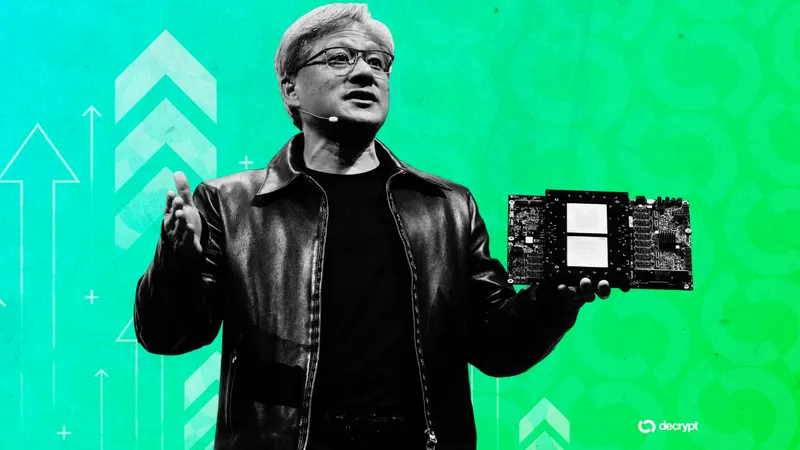
'A Massive Mistake': Tech, AI and Crypto Founders React to Jensen Huang’s Nvidia Exit
Nvidia confirmed the resignation of founder Jensen Huang on Thursday and named CFO Colette Kress interim CEO, sending the company's stock down 14% in a single minute.
The sudden departure of Jensen Huang, who co-founded and led Nvidia for 33 years, has triggered a wave of criticism from influential figures in the technology and cryptocurrency sectors. The board of directors announced on Thursday that Huang would step down as president, CEO, and board member, naming longtime finance chief Colette Kress as interim CEO.
The move came after reports of two extramarital affairs, including one involving a businesswoman that U.S. intelligence officials suspected of links to China. Huang acknowledged being unfaithful to his wife in a message to employees on Sunday, but Nvidia stated in a board statement that it had no reason to believe its secrets or national security were compromised.
The company’s independent investigation remains underway, and allegations about foreign intelligence have not established that Huang knowingly provided information to a foreign government. The scandal was enough for the board to decide to let him go, a decision that has been met with skepticism and concern from the wider tech community.
The market’s reaction was swift and severe. Nvidia shares fell 14% at the opening bell on Thursday, wiping more than $500 billion from U.S. stocks in a single minute. The company, once the most valuable in the world, has now fallen to third on that list.
Huang’s departure raises a particular problem for a company built so closely around its founder: Who, exactly, can replace him? The corporate governance critic Desiree Fixler argued that the board should have consulted shareholders before making the decision, invoking directors’ fiduciary duty to protect investors rather than indulge in what she called a media frenzy.
Crypto and AI leaders condemn the decision
Changpeng “CZ” Zhao, the Binance co-founder and one of crypto’s most influential executives, said the move was a mistake. He argued that Huang’s personal problems should be weighed against the company he built.
“it's a mistake for Nvidia to let Jensen resign.”
Bitcoin entrepreneur Dan Held agreed, writing that he “shouldn't have resigned.” Erik Voorhees, the founder of privacy-focused AI platform Venice, was more confrontational, questioning the evidence against Huang’s wife, Alice.
“What evidence is there that Alice Huang is actually a Chinese spy? The answer, unsurprisingly, is absolutely zero.”
Anthony Pompliano, the Bitcoin investor and commentator, urged the community not to get distracted by the headlines. He emphasized that open-source AI is essential to the freedom of billions of people in the future.
“Do not get distracted by the headlines. Open-source AI is essential to the freedom of billions of people in the future.”
The ousting has fueled speculation of an anti-open-source conspiracy. Nvidia is one of the leading voices in the open-source movement, and some fear that an Nvidia without Huang could become less willing to confront firms that keep their most advanced models behind proprietary services.
Jun Song, an open-source AI advocate and hardware entrepreneur, alleged that OpenAI and Anthropic had spent millions lobbying Congress to restrict open weights. He pointed to a “Pace the Frontier” campaign and argued that Nvidia responded by building the Open Secure AI Alliance, ending his post with, “And today, we lost him.”
The broader conspiracy claim needs, of course, much more evidence. The Pacing the Frontier initiative is a statement from employees at several AI companies seeking tools to slow dangerous frontier development, not proof of a joint corporate campaign to ban all open-weight models or remove Huang.
Reaction from top tech founders
Epic Games founder and CEO Tim Sweeney was among the highest-profile tech executives to condemn the exit. He praised Huang for keeping innovation moving even as Nvidia grew into an enormous company.
“A sad day for NVIDIA, developers, America, and all humanity.”
Perplexity AI co-founder and CEO Aravind Srinivas took a more personal approach, thanking Huang for 33 years of bold leadership. He also credited Huang’s generosity toward other founders, including himself, for helping shape the future of American AI.
“Thank you Jensen Huang for 33 years of bold leadership.”
Peter Steinberger, creator of the open-source OpenClaw agent and now at OpenAI, argued that the decision felt rushed. He suggested that if the goal of the alleged spy was to destabilize one of the most successful American companies, they had achieved their aim.
“If that Spy’s goal was to destabilize one of the most successful American companies, they achieved their goal. Ousting Jensen feels rushed and not right.”
Future outlook for open-source AI
The issue comes with a rather large business backdrop. Nvidia agreed in September to acquire the open-source AI repository Hugging Face for roughly $12.9 billion, subject to regulatory clearance, in a deal expected to close in the first half of 2027.
That arrangement could put both the hardware used to build AI and the largest hub used to distribute open models under one company’s influence. For Voorhees, the controversy also prompted a practical question: “Is there a decentralized Hugging Face yet?”
The concern is more than a slogan for a founder whose Venice AI business is built around private access to open models. Voorhees previously told Decrypt that the antidote to excessive control over AI was “open-source decentralization.”
Some developers saw a deeper threat in Huang’s departure: the loss of a powerful corporate champion of downloadable AI models. The worry is that an Nvidia without Huang could become less willing to confront firms that keep their most advanced models behind proprietary services.
Related
