Critical Red Hat Quay Flaw Lets Attackers Read and Overwrite All Private Container Images in a Registry
Red Hat has disclosed a critical vulnerability in its Quay container registry that allows attackers to read and overwrite all private container images, with fixes released for eight Quay 3 branches.
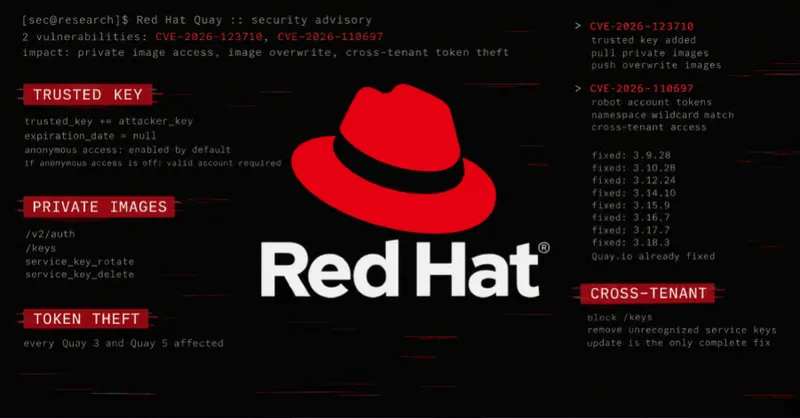
The vulnerability, tracked as CVE-2026-123710 with a CVSS score of 9.8, exists in Quay's key management system. By default, Quay enables anonymous access, allowing attackers without accounts to exploit the flaw. When anonymous access is disabled, anyone with a valid account can still exploit it. The flaw lets attackers add their own trusted key to Quay's key system, which then accepts tokens signed with that key for any repository.
With these tokens, attackers can retrieve private images and any secrets or credentials stored within them. They can also push or overwrite images, with changes propagating to every system that later pulls those images. The planted key persists through restarts until manually removed and can even be used to delete legitimate keys, causing authentication errors for normal operations.
Second Critical Flaw
A second critical flaw, CVE-2026-110697 (CVSS score: 9.9), was disclosed simultaneously. This vulnerability allows Quay users who can create namespaces to steal other tenants' robot account tokens and use them to read, push, or overwrite those tenants' images. The flaw exists in the code that lists robot accounts, which builds an SQL LIKE pattern from the namespace name without properly escaping wildcard characters.
In SQL LIKE an underscore matches any single character.
Impact and Mitigation
The namespace vulnerability allows attackers to match other tenants' namespaces and return their robot accounts with decrypted tokens. No elevated privileges are required, and victims don't need to take any action. Deleting the attacker's namespace also deletes the corresponding robot accounts, potentially cutting off systems that rely on them. When Quay is integrated with OpenShift, stolen robot credentials can be used to inject malicious images into CI/CD pipelines.
Red Hat recommends several immediate steps to mitigate the risks. For the key vulnerability, administrators should block the /keys endpoint at the proxy or load balancer, search audit logs for suspicious key rotation events, remove unrecognized service keys, and install the fixed release. For the namespace flaw, limiting who can create namespaces with underscores and rotating robot tokens can reduce exposure, though updating remains the only complete fix.
The upstream fixes add missing rotation checks, require keys added through the key server to have expiry dates, and prevent callers from choosing a token's audience. These changes address both vulnerabilities. Red Hat has released fixed builds for eight Quay 3 branches, and Quay.io has already been patched for the second flaw.
Related
