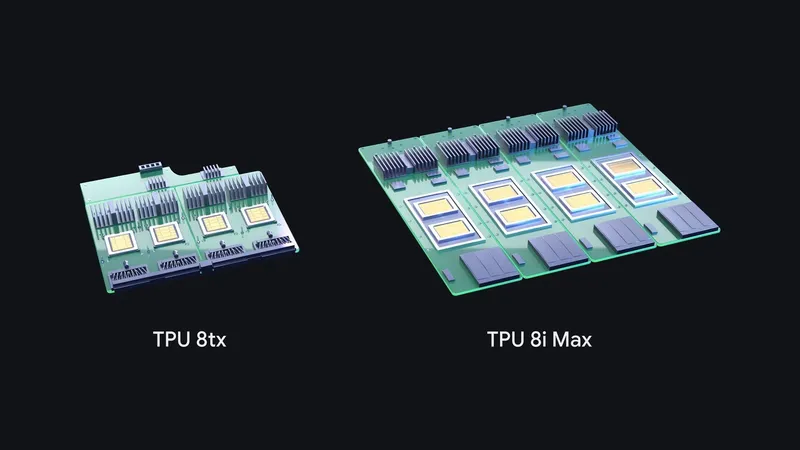
Google reworks TPU silicon into specialized systems for agents and security
Google has added two new specialized chips to its eighth-generation TPU family: TPU 8tx for confidential inference and TPU 8i Max for long-context AI agents.
The tech giant announced TPU 8tx, built on the same silicon as the previously announced 8t, for confidential, hardware-isolated inference aimed at regulated enterprises and governments. The company also introduced TPU 8i Max, which combines two 8i chips on one package specifically designed for long-context agentic work.
Technical upgrades
TPU 8tx swaps the Arm-based Axion hosts of the 8t and 8i for a 5th Gen AMD EPYC CPU, adopting a Boardfly network. Meanwhile, the 8i Max doubles the compute, SRAM, and HBM bandwidth of the original 8i chip.
Market strategy
The original split between TPU 8t for large-scale training and TPU 8i for low-latency inference has now evolved with more specialized options. TPUs have become a fast-growing business for Google, with the company claiming nearly 100 customers including Meta's recent adoption of TPUs.
The more modular approach allows Google to deliver specialized systems "in a matter of months rather than years," accelerating deployment for diverse workloads across industries.
Related
