Electronica: Tria’s OSM-SB-EP5 aims to shorten concept-to-product time - Electronics Weekly
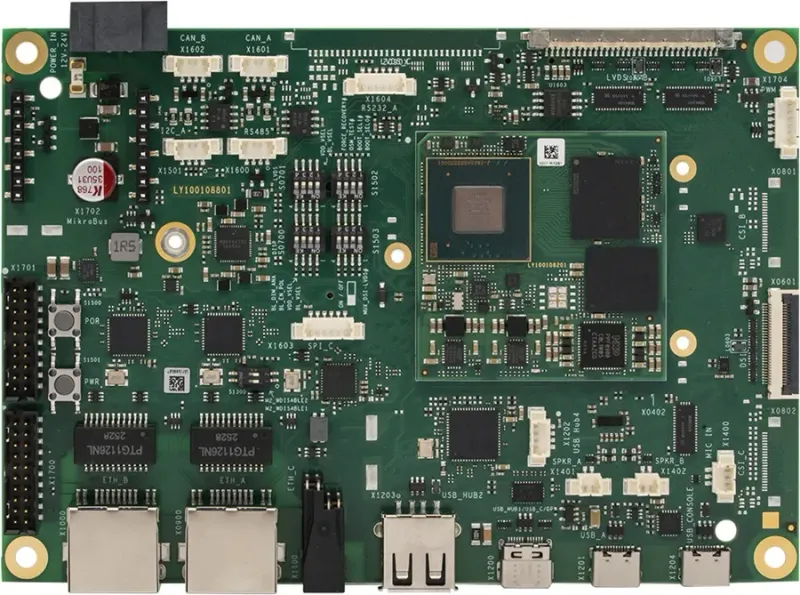
Tria Technologies has introduced the OSM-SB-EP5 carrier board, designed to accelerate the development of embedded products using the Open Standard Module (OSM) standard.
The OSM-SB-EP5 serves as a carrier board for evaluation, validation, and prototyping of OSM-based embedded systems. It enables teams building embedded products around the Open Standard Module standard to assess system architectures, verify application requirements, and reduce project risk.
OSM brings the standardization and flexibility of Computer-On-Module (COM) and System-On-Module (SOM) solutions to smaller and higher volume embedded products, where traditional connector-based modules are too large or expensive.
Accelerated Development
The platform was designed specifically to help engineering teams accelerate the journey from concept to product. Supporting TRIA OSM modules across Size-S, Size-M and Size-L form factors, it enables rapid evaluation, application validation, proof-of-concept development and software bring-up on a single hardware platform.
The OSM-SB-EP5 was designed to help engineering teams accelerate the journey from concept to product.
Technical Features
As a carrier board, the OSM-SB-EP5 acts as a baseboard that breaks out inputs, outputs, and interfaces. The processing power comes from whichever interchangeable OSM module is fitted. Before an application-specific carrier board is available, engineers can use it to test interfaces, assess connectivity requirements, create working proof-of-concepts and begin software development.
Technical features include NOR Flash with Quad SPI, 2x Gigabit Ethernet ports with S/RGMII PHYs, a Single Pair Ethernet (SPE) with SGMII PHY, USB connectivity, LVDS and MIPI-DSI display interfaces, 2x UARTs, 2x CAN buses, internal buses and general IO.
Related
