New Nvidia DLSS rival promises faster frame generation on older AMD, Intel and GeForce GPUs - Notebookcheck
Apex Compute has released a public beta of Apex Neural Rendering, an AI-powered frame generation solution compatible with older Nvidia GeForce, AMD Radeon and Intel Arc graphics cards.
Apex Neural Rendering (ANR) is a suite of AI-powered rendering technologies that includes frame generation, super-resolution upscaling and ray reconstruction. At launch, only the frame generation component is available in beta.
The ANR Frame Generation (ANR FG) beta supports a broad range of hardware, including Nvidia GeForce GTX 16-series and RTX 20-series GPUs or newer, AMD Radeon RX 5000-series GPUs or newer, and Intel Arc A-series and B-series graphics cards. The Steam Deck is also supported.
The software runs on Windows 10/11, Linux and SteamOS through Proton, offering a cross-platform solution for gamers.
Performance claims
Apex Compute has published performance figures that claim its ANR FG outperforms Nvidia's DLSS Frame Generation in speed and memory consumption. On a GeForce RTX 5090 at 4K resolution, ANR FG reportedly generates a frame in 1.01 milliseconds in 2x mode, compared to 1.26 milliseconds for DLSS. At 4x, ANR FG takes 0.61 milliseconds versus 0.82 milliseconds for DLSS.
The company also claims ANR FG uses just 214 MB of GPU memory, significantly less than the 562 MB consumed by DLSS. These figures are presented as first-party benchmarks, and independent testing will be necessary to verify the results.
Faster frame generation alone does not necessarily translate into better overall performance or lower input latency.
Availability and compatibility
The ANR FG beta is currently available on GitHub and relies on OptiScaler. Installation requires modifying individual game directories, which is not as simple as adjusting settings in a game's menu. This manual process means compatibility will vary between different games.
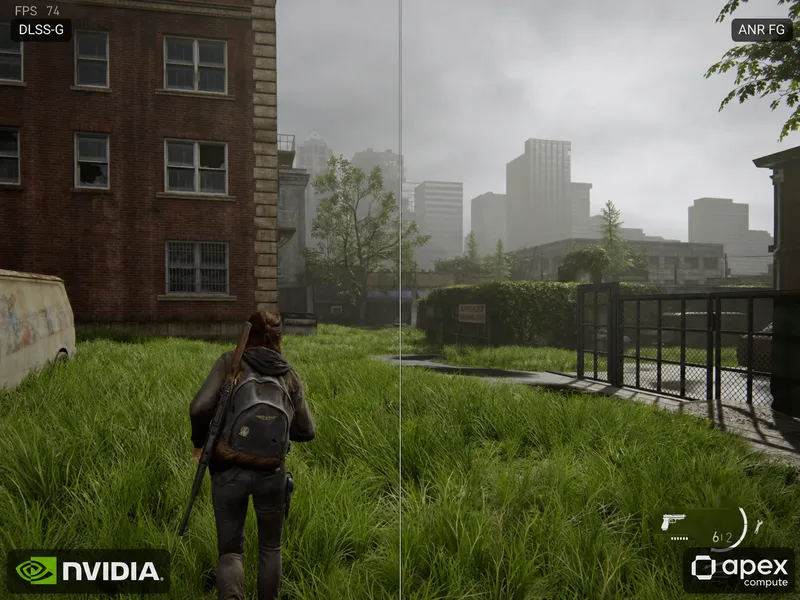
Apex Compute has published side-by-side comparisons, including scenes from The Last of Us Part II, to demonstrate its image quality claims. The remaining components of the ANR suite, super-resolution upscaling and ray reconstruction, are expected to follow later.
Related
