AI Is Trading Your Clients’ Accounts. Can Your Dealing Desk Tell?
AI agents are now trading client accounts on major platforms, but brokers lack clear methods to detect when AI is making trading decisions.
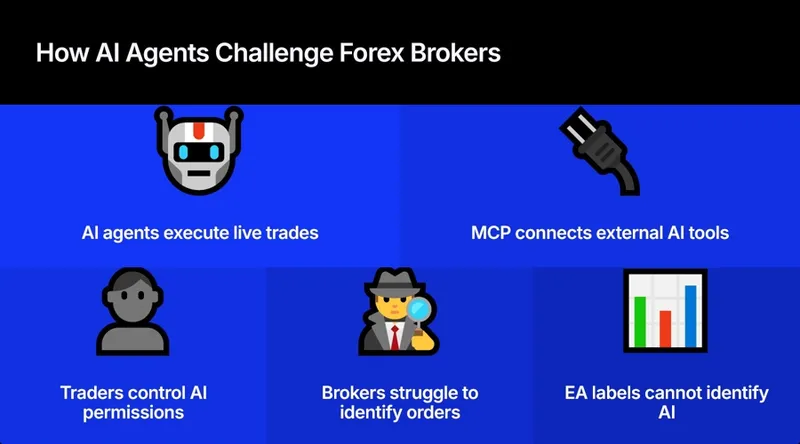
Over the past year, retail FX and CFD brokers have seen a wave of AI integrations, with AI agent trading becoming a standard feature on trading platforms. MetaQuotes introduced native support for the Model Context Protocol (MCP) in MetaTrader 5, while Spotware launched cTrader AI Agent Connect, allowing traders to connect external AI agents like Claude to perform trading operations on live accounts.
Beyond official platform servers, various MCP setups exist, including open-source bridges and custom servers built by traders. Each configuration presents different risks, but all share a core problem: brokers have no clear way to detect when AI is making trading decisions, unlike traditional algorithmic trading.
What MCP Actually Does
MCP is an open standard that establishes common rules for connecting AI agents to other software, functioning like a universal plug for AI. Trading platforms or third parties build MCP servers, allowing compatible AI agents to connect and execute actions such as closing positions. The AI's capabilities depend on the setup, but on official servers, it can perform almost any action a trader would manually.
Setting up AI trading is straightforward. With remote setups, traders use access tokens for their accounts, while local setups connect through the platform on their computer. Traders can typically choose whether the AI can trade independently or requires approval for each transaction. When approval is disabled, AI can open, modify, and close trades autonomously.
Related
